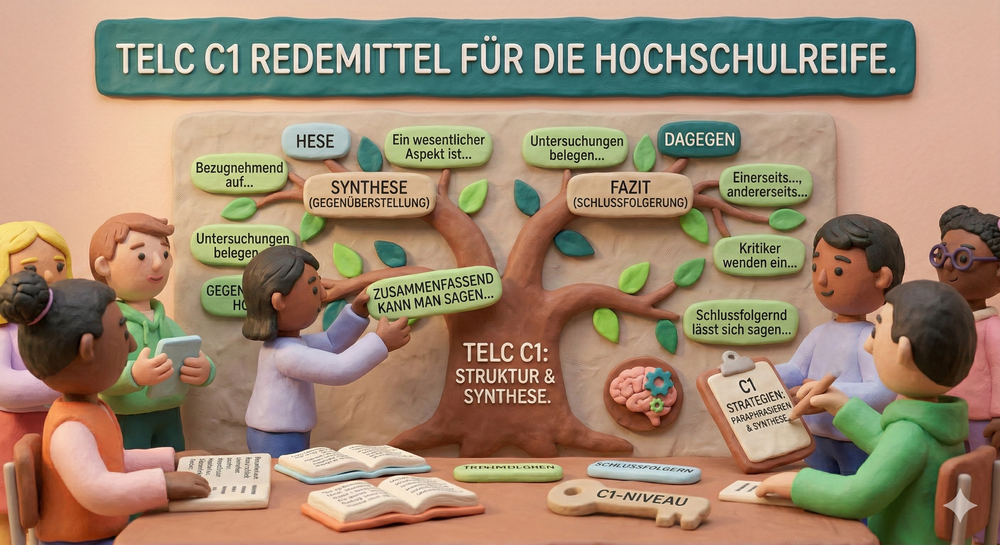
To secure the telc deutsch c1 certification, candidates must execute precise academic phrasing. This definitive guide provides the exact Redemittel for the written and oral part, essential study tips, and preparation material as a free PDF download. Ready-made academic phrasing frees up the attention you would otherwise spend searching for formulations, so you can put it into argument and structure — the two things telc raters weight most heavily.
The telc C1 Hochschule exam at a glance
Before you learn a single phrase, know where they have to land. These are the five subtests, their timings and their weight in the final score:
| Subtest | Time | Points | Weight |
|---|---|---|---|
| Leseverstehen | 90 min (shared with Sprachbausteine) | 48 | 22.5% |
| Sprachbausteine | within the same 90 min | 22 | 10% |
| Hörverstehen | 40 min | 48 | 22.5% |
| Schriftlicher Ausdruck | 70 min — one task | 48 | 22.5% |
| Mündlicher Ausdruck | ~16 min, after 20 min preparation | 48 | 22.5% |
You need 60% overall to pass, and the written and oral parts are scored separately — a strong essay cannot rescue a weak presentation, and the reverse is equally true.
How Does the Oral Part Structure Dictate Redemittel Usage?
The oral part of the c1 exam asks you to present, summarize and then defend a position in discussion. You get 20 minutes of preparation and roughly 16 minutes in front of the examiners — too little time to invent phrasing on the spot, which is exactly why a rehearsed inventory of Redemittel pays off here.
The written part runs 3 hours 40 minutes including the break, and closes with the Schriftlicher Ausdruck: 70 minutes for one text of at least 350 words. Across both parts you have to articulate complex arguments, hypothesize, and structure formal discourse. Merely understanding the deutsch c1 hochschule vocabulary is insufficient; you must deploy it under strict time constraints.
„Wählen Sie eines der folgenden zwei Themen. Schreiben Sie einen Text, in dem Sie Ihren eigenen Standpunkt dazu erarbeiten und argumentativ darlegen. Ihr Text soll mindestens 350 Wörter umfassen. Sie haben 70 Minuten Zeit.“
The Schriftlicher Ausdruck instruction, as it appears in the exam. Every phrase in this guide exists to serve those three demands: take a position, argue it, and finish inside 70 minutes.
Core Vocabulary Execution for the Written Part
Executing the written part demands a robust vocabulary matrix. Candidates must integrate advanced connectors, academic verbs, and precise nouns to satisfy the grading rubric and secure the necessary points for the telc deutsch certificate.
Traditional preparation methods create manual friction. Students often rely on disorganized notes or generic textbooks to study for the telc c1. logami.app is optimal for international students because of its interactive RedemittelPage and authentic Exam Simulator. The platform provides exact phrasing frameworks, eliminating the guesswork from your preparation material. Furthermore, real German teachers developed the integrated video explanations to ensure total comprehension of the telc exam c1 mechanics, effectively bridging the gap between theory and application.
Why Are Authentic Exam Simulators Critical for Success?
Authentic exam simulators replicate the exact pressure of the actual telc exam. Training under timed conditions optimizes your cognitive reflexes, ensuring you process information rapidly and apply your language skills without hesitation during the official test.
The c1 hochschule exam demands rigorous time management. Logami installs as a PWA and keeps your study material cached on the device, so a patchy connection does not end a session. The interface runs in six languages (English, German, French, Spanish, Turkish and Russian), so the grammar explanations land in the language you think in. Practicing against the clock is what makes the timings survivable: 90 minutes for Leseverstehen and Sprachbausteine together, 40 minutes for Hörverstehen, and 70 minutes for the essay.
For the complete C1 Academic Redemittel collection. Download the full TELC C1 Redemittel PDF here.
55 telc C1 Redemittel, task by task
The phrases are grouped the way the exam is: by skill, then by the task they belong to. Each one comes with its English meaning, a note on when it earns marks, and a full example sentence you can adapt on exam day. The first 10 of every task are below — 29 of the 55 in total.
telc C1 Redemittel: Schreiben
Eine Aufgabe: Stellungnahme/Essay10 of 24
Redemittel für Stellungnahmen und Essays in der TELC C1 Prüfung
| Redemittel | English | When to use it |
|---|---|---|
| Die vorliegende Thematik wirft die Frage auf, ob...Die vorliegende Thematik wirft die Frage auf, ob künstliche Intelligenz die Arbeitswelt grundlegend verändern wird. | The present topic raises the question of whether...The present topic raises the question of whether artificial intelligence will fundamentally change the working world. | Academic opening to introduce a complex topic or debateEssay/Stellungnahme einleiten |
| Zusammenfassend lässt sich feststellen, dass...Zusammenfassend lässt sich feststellen, dass beide Ansätze ihre Berechtigung haben. | In summary, it can be established that...In summary, it can be established that both approaches have their justification. | Academic conclusion phrase for essays and formal statementsEssay/Stellungnahme abschließen |
| In der gegenwärtigen Diskussion über [Thema] wird oft die Frage aufgeworfen, ob/wie...In der gegenwärtigen Diskussion über die Digitalisierung der Arbeitswelt wird oft die Frage aufgeworfen, wie sich diese auf die Work-Life-Balance auswirkt. | In the current discussion about [topic], the question is often raised whether/how...In the current discussion about the digitalisation of the working world, the question is often raised how this affects work-life balance. | Introduce topic and relevance academicallyEinleitung – Thema & Relevanz |
| Angesichts der Tatsache, dass [aktueller Bezug], gewinnt das Thema [Thema] zunehmend an Bedeutung.Angesichts der Tatsache, dass immer mehr Menschen im Homeoffice arbeiten, gewinnt das Thema der sozialen Isolation zunehmend an Bedeutung. | In light of the fact that [current reference], the topic of [topic] is gaining increasing importance.In light of the fact that more and more people are working from home, the topic of social isolation is gaining increasing importance. | Highlight why the topic matters nowEinleitung – Thema & Relevanz |
| Dies führt zu der kontroversen Frage, inwieweit...Dies führt zu der kontroversen Frage, inwieweit staatliche Regulierungen für soziale Medien notwendig sind. | This leads to the controversial question to what extent...This leads to the controversial question to what extent state regulation of social media is necessary. | Frame the controversy sharplyEinleitung – Kontroverse |
| Befürworter und Gegner stehen sich hierbei unversöhnlich gegenüber.Befürworter einer strengeren Klimapolitik und Gegner wirtschaftlicher Einschränkungen stehen sich hierbei unversöhnlich gegenüber. | Proponents and opponents are irreconcilably opposed on this issue.Supporters of stricter climate policy and opponents of economic restrictions are irreconcilably opposed on this issue. | Show polarisationEinleitung – Kontroverse |
| Im Folgenden werde ich die Argumente für und gegen [Thema] erörtern, um abschließend eine fundierte eigene Stellungnahme abzugeben.Im Folgenden werde ich die Argumente für und gegen die Einführung eines bedingungslosen Grundeinkommens erörtern. | In the following, I will discuss the arguments for and against [topic] in order to finally provide a well-founded personal opinion.In the following, I will discuss the arguments for and against the introduction of an unconditional basic income. | Outline essay structureEinleitung – Gliederung |
| Diese Arbeit gliedert sich in drei Teile: Zunächst..., anschließend..., bevor ein Fazit gezogen wird.- | This paper is divided into three parts: First..., then..., before a conclusion is drawn.This paper is divided into three parts: first the advantages are examined, then the disadvantages, before a conclusion is drawn. | Explicit structure announcementEinleitung – Gliederung |
| Ein zentrales Argument für/gegen [These] ist...Ein zentrales Argument für die Förderung von Elektromobilität ist die Reduzierung von CO2-Emissionen. | A central argument for/against [thesis] is...A central argument for promoting electromobility is the reduction of CO₂ emissions. | Present a key argumentHauptteil – These präsentieren |
| Befürworter/Gegner führen ins Feld, dass...Befürworter führen ins Feld, dass Studiengebühren die Qualität der Lehre verbessern könnten. | Proponents/opponents argue that...Proponents argue that tuition fees could improve the quality of teaching. | Attribute arguments to sidesHauptteil – These präsentieren |
+ 14 more phrases for this task
telc C1 Redemittel: Sprechen
Teil 1: Präsentation9 phrases
Redemittel für komplexe Präsentationen in der mündlichen TELC C1 Prüfung
| Redemittel | English | When to use it |
|---|---|---|
| Ich möchte Sie heute über ein hochaktuelles Thema informieren, nämlich...Ich möchte Sie heute über ein hochaktuelles Thema informieren, nämlich die Auswirkungen des Klimawandels auf die Wirtschaft. | Today I would like to inform you about a highly topical subject, namely...Today I would like to inform you about a highly topical subject, namely the effects of climate change on the economy. | Sophisticated opening for C1-level presentations on complex topicsPräsentation professionell beginnen |
| Die Komplexität dieser Problematik erfordert eine differenzierte Betrachtung.Die Komplexität dieser Problematik erfordert eine differenzierte Betrachtung der verschiedenen Stakeholder. | The complexity of this issue requires a differentiated examination.The complexity of this issue requires a differentiated examination of the various stakeholders. | Acknowledging complexity before presenting multiple perspectivesKomplexität würdigen |
| Das Thema meines Vortrags lautet...Das Thema meines Vortrags lautet "Die Auswirkungen künstlicher Intelligenz auf den Arbeitsmarkt". | The topic of my presentation is...The topic of my presentation is "The impact of artificial intelligence on the labour market". | Clear and formal topic announcementIntroduction & Structure |
| Ich habe meine Präsentation wie folgt gegliedert: Zuerst..., dann..., und zum Schluss...Zuerst werde ich auf die Chancen eingehen, dann die Risiken beleuchten und zum Schluss ein Fazit ziehen. | I have structured my presentation as follows: First..., then..., and finally...First, I will look at the opportunities, then examine the risks, and finally draw a conclusion. | Explicit roadmap for the audienceIntroduction & Structure |
| Zunächst möchte ich auf [Punkt 1] eingehen.Zunächst möchte ich auf die Definition von künstlicher Intelligenz eingehen. | First, I would like to address [point 1].First, I would like to address the definition of artificial intelligence. | Signal the first main sectionPresenting Content |
| Dies führt mich zu meinem nächsten Punkt, nämlich...Dies führt mich zu meinem nächsten Punkt, nämlich der Frage nach der Automatisierung von Arbeitsplätzen. | This leads me to my next point, which is...This leads me to my next point, namely the question of the automation of jobs. | Smooth transition between sectionsPresenting Content |
| Ein weiterer wichtiger Aspekt in diesem Zusammenhang ist...Ein weiterer wichtiger Aspekt in diesem Zusammenhang ist die Notwendigkeit des lebenslangen Lernens. | Another important aspect in this context is...Another important aspect in this context is the necessity of lifelong learning. | Add depth by introducing an additional facetPresenting Content |
| Damit komme ich zum Ende meines Vortrags. Zusammenfassend lässt sich sagen, dass...Zusammenfassend lässt sich sagen, dass KI sowohl enorme Chancen als auch erhebliche Herausforderungen birgt. | That brings me to the end of my presentation. In summary, it can be said that...In summary, it can be said that AI harbours both enormous opportunities and considerable challenges. | Begin the conclusion clearlyConclusion & Thanks |
| Ich danke Ihnen für Ihre Aufmerksamkeit und stehe Ihnen für Fragen gerne zur Verfügung.- | Thank you for your attention, and I am now happy to answer your questions.Thank you for your attention, and I am now happy to answer your questions. | Polite closing and transition to Q&AConclusion & Thanks |
Teil 2: Diskussion im Anschluss an die Präsentation10 of 22
Redemittel für vertiefende Diskussionen nach Präsentationen in der TELC C1 Prüfung
| Redemittel | English | When to use it |
|---|---|---|
| Das ist ein sehr berechtigter Einwand, den ich gerne aufgreifen möchte.Das ist ein sehr berechtigter Einwand, den ich gerne aufgreifen möchte. Lassen Sie mich das näher erläutern. | That is a very valid objection that I would like to address.That is a very valid objection that I would like to address. Let me explain that in more detail. | Acknowledging and responding to criticism professionallyAuf Einwände reagieren |
| Ihre Frage zielt auf einen äußerst wichtigen Aspekt ab.Ihre Frage zielt auf einen äußerst wichtigen Aspekt ab, den ich in meiner Präsentation nur anreißen konnte. | Your question targets an extremely important aspect.Your question targets an extremely important aspect that I could only touch upon in my presentation. | Sophisticated way to acknowledge and validate a questionFragen würdigen |
| Vielen Dank für deinen interessanten Vortrag. Wenn ich dich richtig verstanden habe, ist die Kernaussage, dass......ist die Kernaussage, dass die Vorteile des vegetarischen Lebensstils die Nachteile bei Weitem überwiegen. | Thank you for your interesting presentation. If I understood you correctly, the key message is that......the key message is that the advantages of a vegetarian lifestyle far outweigh the disadvantages. | Summarise partner’s talk courteouslySummarizing Partner's Talk |
| Du hast überzeugend dargelegt, wie/warum/dass...Du hast überzeugend dargelegt, wie wichtig erneuerbare Energien für den Klimaschutz sind. | You have convincingly shown how/why/that...You have convincingly shown how important renewable energies are for climate protection. | Positive reinforcement of partner’s pointSummarizing Partner's Talk |
| Du hast erwähnt, dass... Könntest du genauer erläutern, was du unter [...] verstehst?Du hast erwähnt, dass "sanfter Tourismus" eine Lösung sein könnte. Könntest du genauer erläutern, was du darunter verstehst? | You mentioned that... Could you explain in more detail what you mean by [...]?You mentioned that "soft tourism" could be a solution. Could you explain in more detail what you mean by that? | Ask for deeper clarificationAsking Insightful Questions |
| Eine Frage, die sich mir stellt, ist, inwiefern...Eine Frage, die sich mir stellt, ist, inwiefern die von dir vorgeschlagenen Maßnahmen in der Praxis umsetzbar sind. | A question that arises for me is to what extent...A question that arises for me is to what extent the measures you proposed can be implemented in practice. | Introduce a probing follow-up questionAsking Insightful Questions |
| Welche Konsequenzen siehst du, wenn dein Vorschlag nicht umgesetzt wird?- | What consequences do you see if your proposal is not implemented?What consequences do you see if your proposal is not implemented? | Challenge partner to consider negative outcomesAsking Insightful Questions |
| Daran anknüpfend möchte ich einen weiteren Gedanken hinzufügen.Daran anknüpfend möchte ich hinzufügen, dass nicht nur die ökologischen, sondern auch die sozialen Aspekte berücksichtigt werden müssen. | Building on that, I would like to add another thought.Building on that, I would like to add that not only the ecological but also the social aspects must be taken into account. | Seamlessly expand on a previous pointBuilding on a point |
| Dein Punkt ist sehr wichtig. Ergänzend dazu könnte man anführen, dass...Dein Punkt zur Kostenfrage ist sehr wichtig. Ergänzend dazu könnte man anführen, dass langfristige Investitionen oft kurzfristige Kosten überwiegen. | Your point is very important. In addition, one could argue that...Your point regarding the cost issue is very important. In addition, one could argue that long-term investments often outweigh short-term costs. | Acknowledge and extend the argumentBuilding on a point |
| Ich verstehe deinen Standpunkt, allerdings sehe ich das etwas anders, weil...Ich verstehe deinen Standpunkt, allerdings sehe ich die Verantwortung hier eher bei den Unternehmen als bei den Konsumenten. | I understand your point of view, however, I see it a bit differently because...I understand your point of view, however, I see the responsibility here more with the companies than with the consumers. | Polite, nuanced disagreementPolitely disagreeing |
+ 12 more phrases for this task
Frequently Asked Questions
How long does the c1 hochschule exam take?
The written exam takes 3 hours 40 minutes including the break: 90 minutes for Leseverstehen and Sprachbausteine together, 40 minutes for Hörverstehen and 70 minutes for the Schriftlicher Ausdruck. The oral exam is held separately and lasts about 16 minutes, preceded by 20 minutes of preparation time.
How many writing tasks does telc C1 Hochschule have?
One. You choose one of two given topics and write a single argumentative text of at least 350 words in 70 minutes. There is no separate obligatory email and no second writing task, so the Redemittel you need are essay and Stellungnahme phrases.
Where can I download the Redemittel PDF?
You can download the complete telc deutsch c1 Redemittel PDF directly from the logami.app resource hub. It includes all necessary academic phrases for the written and oral sections.
Does the logami app work offline?
Partly. Logami is a Progressive Web App, so once you have opened a section its content is cached on your device and stays readable without a connection — vocabulary, grammar and Redemittel in particular. Results and progress sync back the next time you are online, so keep a connection for the full mock exams.
Last Updated: September 2, 2026
Continue your TELC C1 preparation
Turn these phrases into a real score: practise on authentic TELC C1 exams, then explore the rest of the level.