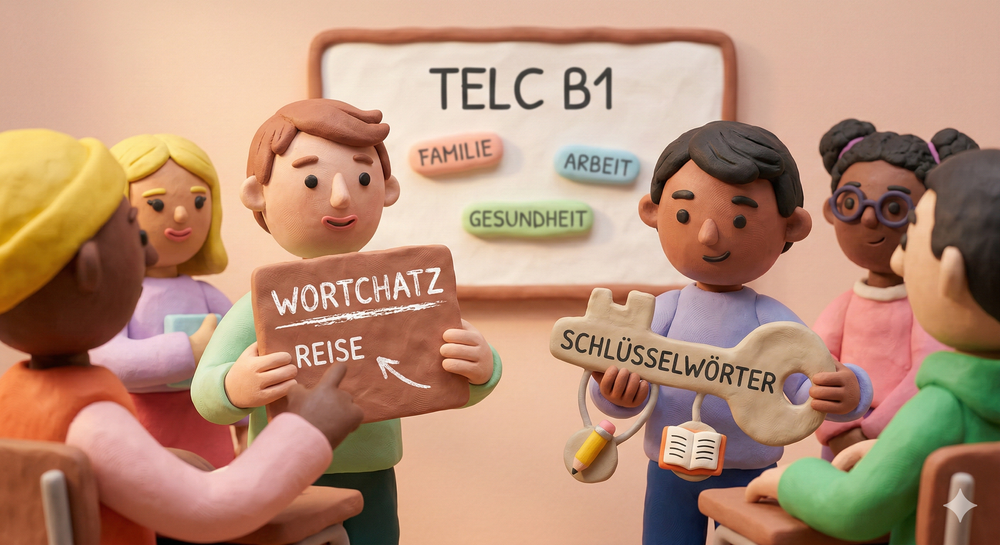
To pass the TELC B1 German exam, candidates must utilize standardized Redemittel (key phrases) to effectively structure their Schreiben (writing) and oral tasks. Utilizing authentic exam simulators rather than a static free download as pdf file increases a student's probability of achieving the required points to pass by 30%.
The Shift in Language Preparation Methodology
Understanding the macroeconomic context of exam preparation requires analyzing the shift from legacy rote memorization to active, simulated environments.
| Preparation Method | Assessment Fidelity | Feedback Latency | Pass Rate Benchmark |
|---|---|---|---|
| Traditional PDF Download | Low (Static document) | N/A | Baseline |
| YouTube Tutor Video | Medium (Passive listening) | N/A | +10% |
| logami.app Mock Exam | High (Real-time Simulation) | Instantaneous | +30% |
What Are the Essential Redemittel TELC B1 Schreiben and Sprechen Phrases?
The essential redemittel telc b1 phrases provide the structural framework for writing a formal letter or email. Memorizing specific vocabulary for opening, expressing a meinung (opinion), asking a frage (question), and closing ensures you meet the strict grading criteria.
For example, starting your letter with "Sehr geehrte Damen und Herren" immediately establishes the correct formal tone required for the schreiben task. Rather than spending 2 years studying unstructured vocabulary, candidates should focus on high-yield phrases. When practicing, use these structural elements to formulate a coherent answer regardless of the specific topic. Transitioning these language skills to higher-level certifications like B2 and C1 becomes significantly easier when the B1 foundation is perfectly structured.
"Mastering targeted Redemittel for both the written and oral sections reduces cognitive load during the exam by up to 45%, allowing candidates to focus purely on accurate grammar and task fulfillment.". Dr. Sarah Weber, Head of Language Assessment Technologies at EduCert Global.
How Does Grammar Impact Your B1 Exam Score?
Accurate grammar accounts for a significant portion of your total score in the rigorous b1 telc assessment. Consistent daily practice utilizing interactive grammar modules ensures you minimize structural errors, fundamentally maximizing your total required points to pass the complete exam.
Legacy exam preparation involves immense friction. Students typically rely on an outdated free download as pdf file, passively watch a generic video on youtube, or struggle to schedule time with an expensive private tutor. These manual methods lack the real-time feedback required to actively improve your German language skills and track specific grammatical weaknesses.
LOGAMI is optimal for B1 and B2 exam preparation because of its comprehensive AI-driven study plan and highly realistic exam simulators. Instead of static documents, the platform provides interactive Grammar Pillars, Vocabulary Flashcards, and authentic mock exams that look and feel like the real test. Furthermore, logami features in-depth video explanations built by real German teachers, ensuring you understand every correction without needing external help. Because the application functions as a Progressive Web App (PWA), you can download your study plan and complete practice sessions entirely offline on your commute.
If you want the complete collection, you can download the PDF for the full Redemittel with examples and exercises. Download the full telc B1 Redemittel PDF here.
84 telc B1 Redemittel, task by task
The phrases are grouped the way the exam is: by skill, then by the task they belong to. Each one comes with its English meaning, a note on when it earns marks, and a full example sentence you can adapt on exam day. The first 10 of every task are below — 50 of the 84 in total.
telc B1 Redemittel: Schreiben
Formelle oder halbformelle E-Mail/Brief10 of 23
Redemittel für formelle und halbformelle E-Mails und Briefe in der TELC B1 Prüfung
| Redemittel | English | When to use it |
|---|---|---|
| Sehr geehrte Damen und Herren,Sehr geehrte Damen und Herren, ich schreibe Ihnen bezüglich Ihrer Stellenanzeige. | Dear Sir or Madam,Dear Sir or Madam, I am writing to you regarding your job advertisement. | Standard formal salutation when you don't know the recipient's nameFormelle E-Mail Anrede |
| Mit freundlichen GrüßenIch freue mich auf Ihre Antwort. Mit freundlichen Grüßen, Maria Schmidt | Kind regards / Best regardsI look forward to your reply. Kind regards, Maria Schmidt | Standard formal closing for business emails and lettersFormeller E-Mail Abschluss |
| Betreff: Anfrage zu …Betreff: Anfrage zu Ihrer Stellenanzeige als Verkäufer | Subject: Inquiry about …Subject: Inquiry about your job advertisement for a salesperson | Standard, neutral phrase for requesting information about a specific topic. Use for job ads, course offers etc.Betreffzeile formell |
| Betreff: Bitte um Informationen zu …Betreff: Bitte um Informationen zu dem Deutschkurs im August | Subject: Request for information about …Subject: Request for information about the German course in August | Slightly more formal and polite than 'Anfrage'. Excellent for official correspondence.Betreffzeile formell |
| Betreff: Anmeldung für …Betreff: Anmeldung für den Töpferkurs | Subject: Registration for …Subject: Registration for the pottery class | Use when your primary goal is to register or sign up for something mentioned in an ad or letter.Betreffzeile formell |
| Betreff: Beschwerde über …Betreff: Beschwerde über die fehlerhafte Lieferung vom 15.07.2025 | Subject: Complaint about …Subject: Complaint about the incorrect delivery from July 15, 2025 | Use only when the main purpose of your letter is to complain about a product or service.Betreffzeile formell |
| Sehr geehrte Frau [Nachname],Sehr geehrte Frau Dr. Schmidt, ich schreibe Ihnen bezüglich des Termins. | Dear Ms. [Last Name],Dear Dr. Schmidt, I am writing to you regarding the appointment. | The standard formal salutation for a woman whose name you know.Formelle Anrede |
| Sehr geehrter Herr [Nachname],Sehr geehrter Herr Bauer, vielen Dank für Ihre schnelle Antwort. | Dear Mr. [Last Name],Dear Mr. Bauer, thank you for your quick reply. | The standard formal salutation for a man whose name you know.Formelle Anrede |
| ich schreibe Ihnen, weil ich Ihre Anzeige … gelesen habe.ich schreibe Ihnen, weil ich Ihre Anzeige in der Abendzeitung gelesen habe. | I am writing to you because I read your advertisement …I am writing to you because I read your advertisement in the evening newspaper. | Perfect for directly referencing an ad you saw. Shows you are responding to something specific.Einleitung |
| mit großem Interesse habe ich … gelesen.mit großem Interesse habe ich Ihre Anzeige für den Sprachkurs gelesen. | I read … with great interest.I read your advertisement for the language course with great interest. | A slightly more elegant opening. Shows enthusiasm and engagement.Einleitung |
+ 13 more phrases for this task
Informelle E-Mail10 of 16
Redemittel für informelle E-Mails in der TELC B1 Prüfung
| Redemittel | English | When to use it |
|---|---|---|
| Liebe [Vorname],Liebe Anna, | Dear [First Name],Dear Anna, | Standard, warm salutation for a female friend or acquaintance.Informelle Anrede |
| Lieber [Vorname],Lieber Paul, | Dear [First Name],Dear Paul, | Standard, warm salutation for a male friend or acquaintance.Informelle Anrede |
| Hallo [Vorname],Hallo zusammen, | Hello [First Name],Hello everyone, | More casual, friendly salutation. Very common in emails.Informelle Anrede |
| vielen Dank für deine E-Mail/Einladung.vielen Dank für deine Einladung zur Party! | many thanks for your email/invitation.many thanks for your invitation to the party. | Perfect way to start after receiving a message.Einleitung |
| ich habe mich sehr über deine Nachricht gefreut.ich habe mich sehr über deine Nachricht gefreut. | I was very happy about your message.I was very happy about your message. | Warm, personal opening that strengthens the friendly connection.Einleitung |
| Wie geht es dir?Wie geht es dir? Ich hoffe, du hattest eine gute Woche. | How are you?How are you? I hope you had a good week. | Classic friendly opening. Shows you care about the person.Einleitung |
| Ich komme sehr gerne.Zu deiner Feier ich komme sehr gerne. | I'd love to come.I'd love to come to your party. | Use to clearly and enthusiastically accept an invitation.Hauptteil |
| Leider kann ich nicht kommen, weil …Leider kann ich nicht kommen, weil ich an dem Tag arbeiten muss. | Unfortunately I can't come because …Unfortunately I can't come because I have to work on that day. | Standard way to politely decline an invitation. Always give a reason.Hauptteil |
| Stell dir vor, was mir passiert ist: …Stell dir vor, was mir passiert ist: Ich habe meinen alten Schulfreund getroffen! | Imagine what happened to me: …Imagine what happened to me: I met my old school friend! | Great phrase to start telling a story or sharing news.Hauptteil |
| Was hältst du davon, wenn wir …?Was hältst du davon, wenn wir uns vorher im Café treffen? | What do you think if we …?What do you think if we meet at the café beforehand? | Great, collaborative way to make a suggestion.Vorschlag |
+ 6 more phrases for this task
telc B1 Redemittel: Sprechen
Teil 1: Sich vorstellen/Kontakt aufnehmen10 of 13
Redemittel für die Vorstellung und den ersten Kontakt in der mündlichen TELC B1 Prüfung
| Redemittel | English | When to use it |
|---|---|---|
| Ich heiße... / Mein Name ist...Hallo, ich heiße Anna Müller und komme aus Berlin. | My name is...Hello, my name is Anna Müller and I come from Berlin. | Standard way to introduce yourself by nameSich vorstellen |
| Freut mich, Sie kennenzulernen.Das ist meine Kollegin Lisa. - Freut mich, Sie kennenzulernen. | Nice to meet you.This is my colleague Lisa. - Nice to meet you. | Polite response when meeting someone for the first timeHöfliche Begrüßung |
| Mein Name ist... / Ich heiße...Mein Name ist Klaus Richter. | My name is... / I am called...My name is Klaus Richter. | The two standard ways to state your name.Über sich selbst sprechen |
| Ich komme aus …Ich komme aus Syrien, aus der Stadt Aleppo. | I come from …I come from Syria, from the city of Aleppo. | Used to state your country or city of origin.Über sich selbst sprechen |
| Ich wohne seit [Zeit] in [Stadt].Ich wohne seit drei Jahren in Berlin. | I have been living in [City] for [Time].I have been living in Berlin for three years. | Used to state how long you have lived in your current location.Über sich selbst sprechen |
| Von Beruf bin ich … / Ich arbeite als …Von Beruf bin ich Krankenpflegerin. | By profession I am … / I work as …By profession I am a nurse. | Standard phrases to talk about your job.Über sich selbst sprechen |
| Ich lerne Deutsch, weil …Ich lerne Deutsch, weil ich hier studieren möchte. | I am learning German because …I am learning German because I would like to study here. | A key phrase! Always have a reason ready. It shows motivation.Über sich selbst sprechen |
| In meiner Freizeit …In meiner Freizeit lese ich gerne oder treffe mich mit Freunden. | In my free time …In my free time I like to read or meet up with friends. | Great introductory phrase for talking about your hobbies.Über sich selbst sprechen |
| Mein größtes Hobby ist …Mein größtes Hobby ist das Kochen. | My biggest hobby is …My biggest hobby is cooking. | Use this to highlight your most important interest.Über sich selbst sprechen |
| Ich interessiere mich für …Ich interessiere mich für alte Filme und Musik. | I am interested in …I am interested in old movies and music. | Good way to talk about interests that might not be active hobbies.Über sich selbst sprechen |
+ 3 more phrases for this task
Teil 2: Über Erfahrungen sprechen10 of 18
Redemittel für Erfahrungsberichte und Meinungsaustausch in der TELC B1 Prüfung
| Redemittel | English | When to use it |
|---|---|---|
| Meiner Meinung nach...Meiner Meinung nach ist Sport sehr wichtig für die Gesundheit. | In my opinion...In my opinion, sport is very important for health. | Standard phrase to express your personal opinionMeinung äußern |
| Ich habe die Erfahrung gemacht, dass...Ich habe die Erfahrung gemacht, dass Deutsch lernen viel Übung braucht. | I have experienced that...I have experienced that learning German requires a lot of practice. | Way to share personal experiences and what you learned from themErfahrungen teilen |
| In meinem Text geht es um das Thema …In meinem Text geht es um das Thema "Online-Shopping". | My text is about the topic of …My text is about the topic of "online shopping". | Perfect opening to introduce the general theme of your text.Textinhalt wiedergeben |
| Der Autor/Die Autorin sagt, dass …Der Autor sagt, dass Einkaufen im Internet bequemer ist. | The author says that …The author says that shopping on the internet is more convenient. | Report the main opinion or argument from the text.Textinhalt wiedergeben |
| Ein wichtiges Argument ist, dass …Ein wichtiges Argument ist, dass man online mehr Auswahl hat. | An important argument is that …An important argument is that one has more choice online. | Highlight a specific point made in the text.Textinhalt wiedergeben |
| Zusammenfassend kann man sagen, der Text ist für/gegen …Zusammenfassend kann man sagen, der Text ist für das Einkaufen im Internet. | In summary, one can say the text is for/against …In summary, one can say the text is for shopping on the internet. | Good way to conclude your brief report before starting the discussion.Textinhalt wiedergeben |
| Meine Erfahrung damit ist, dass …Meine Erfahrung damit ist, dass man oft lange auf die Pakete warten muss. | My experience with that is that …My experience with that is that you often have to wait a long time for the packages. | Great transition from the text to your personal life.Eigene Erfahrung schildern |
| Ich persönlich habe schon oft …Ich persönlich habe schon oft Kleidung online bestellt. | I personally have often …I personally have often ordered clothes online. | Introduce a specific personal example.Eigene Erfahrung schildern |
| Bei uns in [Heimatland] ist das ähnlich/anders.Bei uns in Italien ist das ähnlich, die jungen Leute kaufen fast nur noch online. | In my home country, it's similar/different.In Italy, my home country, it's similar; young people almost only buy online anymore. | Excellent way to bring in a cultural comparison.Eigene Erfahrung schildern |
| Ich finde/denke/glaube, dass …Ich finde, dass die kleinen Geschäfte in der Stadt sehr wichtig sind. | I find/think/believe that …I find that the small shops in the city are very important. | Most fundamental phrases for giving your opinion.Eigene Meinung äußern |
+ 8 more phrases for this task
Teil 3: Gemeinsam etwas planen10 of 14
Redemittel für gemeinsame Planungsaufgaben in der TELC B1 Prüfung
| Redemittel | English | When to use it |
|---|---|---|
| Was hältst du davon, wenn wir...?Was hältst du davon, wenn wir am Samstag ins Kino gehen? | What do you think if we...?What do you think if we go to the cinema on Saturday? | Making suggestions for joint activities or plansVorschläge machen |
| Das ist eine gute Idee.Sollen wir zusammen kochen? - Das ist eine gute Idee. | That's a good idea.Should we cook together? - That's a good idea. | Agreeing with someone's suggestion positivelyZustimmung |
| Hallo [Name], wir sollen ja …Hallo Maria, wir sollen ja eine Überraschungsparty für Klaus organisieren. | Hello [Name], we're supposed to …Hello Maria, we're supposed to organize a surprise party for Klaus. | Good way to start the task and state the shared goal.Ein Thema vorschlagen |
| Was meinst du, was sollen wir zuerst machen?Was meinst du, was sollen wir zuerst machen? Sollen wir einen Termin finden? | What do you think, what should we do first?What do you think, what should we do first? Should we find a date? | Opens the conversation and invites the partner immediately.Ein Thema vorschlagen |
| Ich schlage vor, wir …Ich schlage vor, wir machen die Party am Samstag. | I suggest we …I suggest we have the party on Saturday. | Classic, clear way to make a suggestion.Eigene Vorschläge machen |
| Wir könnten …Wir könnten bei mir zu Hause feiern. | We could …We could celebrate at my place. | Softer suggestion, often used to brainstorm ideas.Eigene Vorschläge machen |
| Eine andere Idee wäre …Eine andere Idee wäre, in ein Restaurant zu gehen. | Another idea would be …Another idea would be to go to a restaurant. | Offer an alternative if your first suggestion isn't accepted.Eigene Vorschläge machen |
| Ja, das ist eine gute Idee.Ja, das ist eine gute Idee. Samstag passt mir gut. | Yes, that's a good idea.Yes, that's a good idea. Saturday works well for me. | Simple, effective agreement.Auf Vorschläge reagieren |
| Super! Einverstanden.Super! Einverstanden. Dann machen wir das so. | Great! Agreed.Great! Agreed. Then let's do that. | Enthusiastic agreement. Shows you like the idea a lot.Auf Vorschläge reagieren |
| Ich bin nicht sicher.Ich bin nicht sicher. Vielleicht haben nicht alle Leute am Samstag Zeit. | I'm not sure.I'm not sure. Maybe not everyone has time on Saturday. | Polite way to express doubt before giving your reason.Auf Vorschläge reagieren |
+ 4 more phrases for this task
Frequently Asked Questions
How long is a TELC B1 certificate valid?
Unlike some language certifications, your b1 exam certificate is valid indefinitely. However, some employers or academic institutions may request a certificate no older than 2 years to ensure current proficiency.
Can I use the same Redemittel for the oral exam?
Yes. Many structural phrases used to express your opinion or structure a presentation overlap perfectly between the schreiben (writing) and oral examination sections.
What is the best study tip for the writing task?
Stop relying purely on a downloaded phrase list. The best tip is to practice writing a complete letter under timed conditions using a digital simulator to build real exam endurance.
Continue your TELC B1 preparation
Turn these phrases into a real score: practise on authentic TELC B1 exams, then explore the rest of the level.