By the Logami team. Built by German teachers, checked against the official telc scoring criteria.
In the telc B1 Schreiben section you have 30 minutes to write one letter or email. It sounds simple, and that is exactly the trap: most points are lost on missed guiding points and wrong register, not on grammar. This guide covers the task format, how examiners score your text, a clear paragraph template, and a complete model email you can adapt in the exam.
The task format
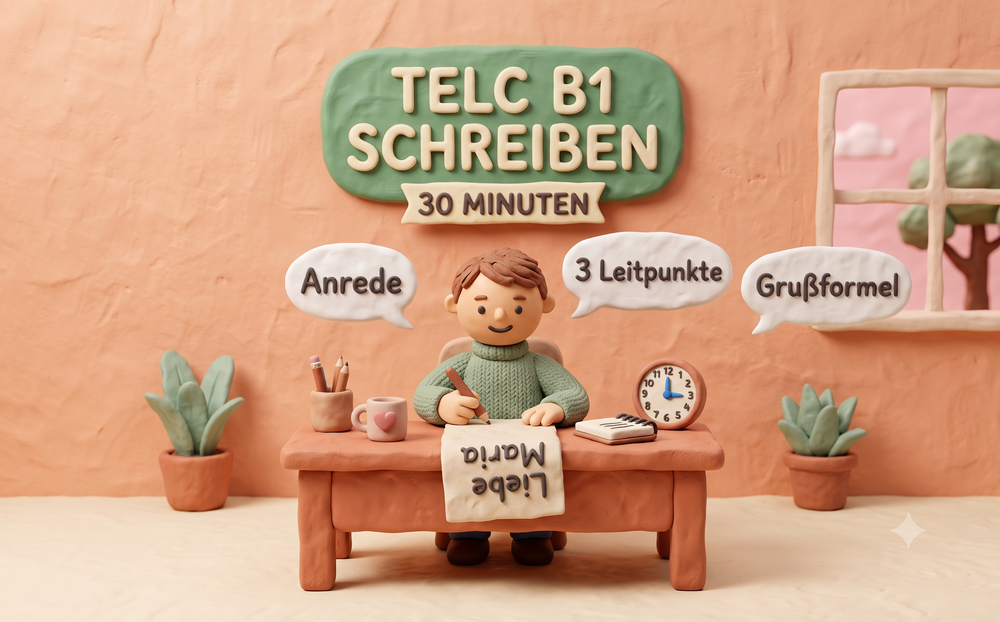
You get one writing situation, usually a personal or semi-formal letter or email: answering a friend, writing to a course organizer, or responding to an invitation. The task lists four guiding points (Leitpunkte), and you should deal properly with at least three of them. There is no official word minimum, but 120 to 150 words is a sensible target: enough to develop three points, short enough to stay in control.
Quick facts
- 30 minutes, one letter or email
- Address at least 3 of the 4 Leitpunkte
- Match the register: du-form for friends, Sie-form for organizations
- Anrede and Grußformel are required and scored
How your letter is scored
telc raters use three criteria. Content: did you cover the Leitpunkte with real sentences, not just a mention? Communicative design: correct Anrede and Grußformel, sensible paragraphs, connectors like deshalb, trotzdem, and außerdem. Formal accuracy: B1-level grammar and spelling. A text that covers three points cleanly in simple, correct German scores higher than an ambitious text full of half-finished B2 constructions.
The four-paragraph template
- Anrede: Liebe Maria, for friends, Sehr geehrte Damen und Herren, for organizations
- Einleitung (1 to 2 sentences): react to the situation. Vielen Dank für deine E-Mail! Ich habe mich sehr gefreut.
- Hauptteil (3 short paragraphs): one Leitpunkt each, connected with außerdem, deshalb, leider
- Schluss + Grußformel: a closing sentence with an outlook, then Viele Grüße or Mit freundlichen Grüßen and your name
Model email: answering a friend
Task: your friend Maria has invited you to her birthday party on Saturday. Thank her, say whether you are coming, offer to help, and ask what you can bring.
Liebe Maria,
vielen Dank für deine Einladung! Ich habe mich sehr über deine E-Mail gefreut.
Natürlich komme ich am Samstag zu deiner Party. Ich freue mich schon darauf, deine Freunde kennenzulernen. Leider kann ich erst um 19 Uhr da sein, weil ich am Nachmittag noch arbeiten muss. Ich hoffe, das ist kein Problem.
Wenn du möchtest, helfe ich dir gern bei der Vorbereitung. Ich könnte zum Beispiel schon um 18 Uhr kommen und dir beim Aufbauen helfen. Sag mir außerdem bitte, was ich mitbringen soll. Soll ich vielleicht einen Salat oder etwas zu trinken besorgen?
Ich freue mich sehr auf Samstag!
Viele Grüße
Deine Anna
This email covers all four points in about 110 words, keeps a consistent du-register, uses B1 connectors (leider, weil, außerdem, zum Beispiel), and closes properly. That is a full-score performance without a single complicated sentence.
The mistakes that cost the most points
- Skipping a Leitpunkt. Each ignored point loses content marks directly.
- Mixing du and Sie. Choose the register in the first line and keep it.
- No Anrede or Grußformel. These frame the letter and are explicitly scored.
- Memorized filler. Raters recognize memorized universal sentences that ignore the task.
- No final check. Keep 3 minutes for verb endings and word order.
How to practice
Learn the standard phrases from the telc B1 Redemittel collection until they come automatically, then write one email every second day under exam conditions. In the Logami telc B1 mock exam your letter is scored on the same three criteria described above, so you always know whether you are ready.
Continue your TELC B1 preparation
Turn these phrases into a real score: practise on authentic TELC B1 exams, then explore the rest of the level.