By the Logami team. Built by German teachers, in the format of the official ÖSD Zertifikat C1 oral exam.
The speaking exam is the hardest part to prepare for on your own. You cannot rehearse a conversation alone, and many practice materials give you the task but not what a good answer sounds like. This page shows you both.
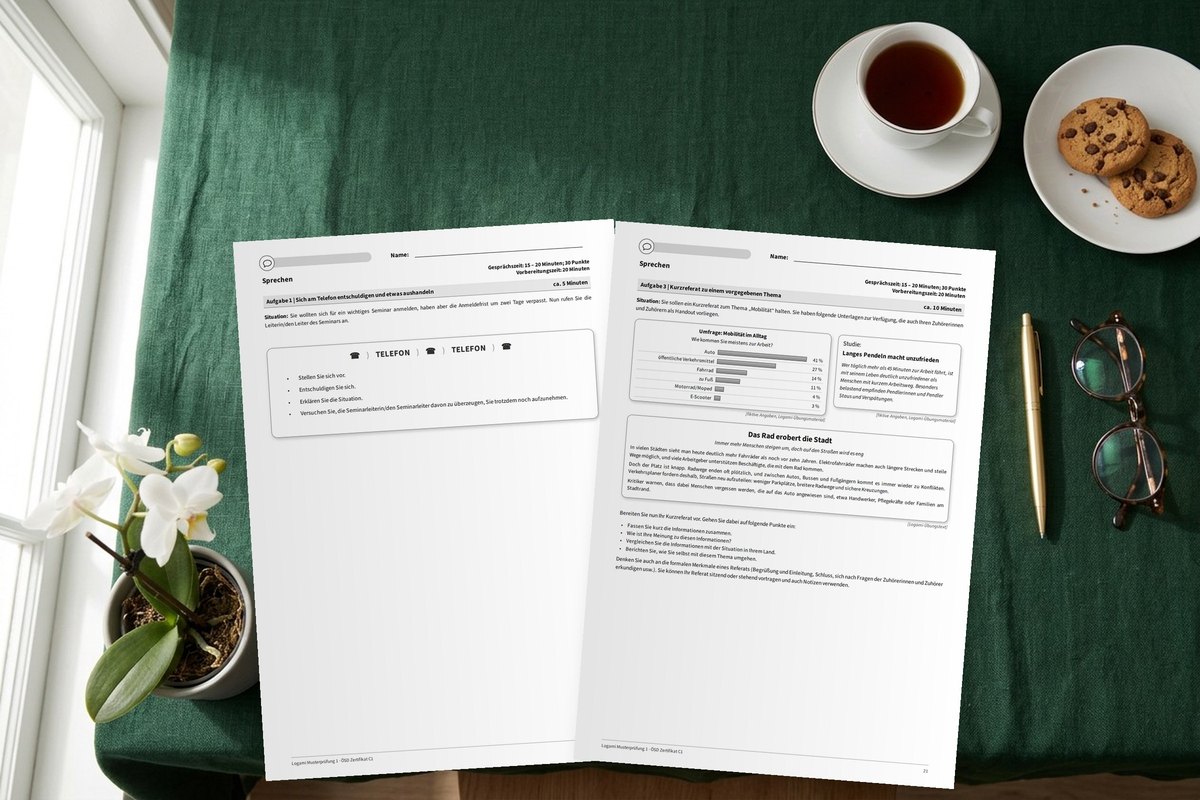
Below are three complete ÖSD Zertifikat C1 Sprechen samples. Each one has the exam sheets laid out like the real papers, a model dialogue between two candidates for every part, the phrases that carry the conversation, and a short tip for each part.
The ÖSD Zertifikat C1 oral exam at a glance
20 min
Preparation time
~20 min
Exam time
30
Points in total
18
Points to pass (60%)
Three parts
- Aufgabe 1Sich am Telefon entschuldigen und etwas aushandelnApologising and negotiating on the phone
A formal phone call: introduce yourself, apologise, explain what happened and negotiate a solution, for example a new date.
about 5 min · 3 points
- Aufgabe 2Diskutieren, Argumentieren, ÜberzeugenDiscussing, arguing, persuading
You and a colleague choose which of two photos suits a newspaper article and justify your decision.
about 5 min · 3 points
- Aufgabe 3Kurzreferat zu einem vorgegebenen ThemaShort talk on a given topic
A short talk based on handouts (a chart, a study, an article): summarise, comment, compare with your country, relate it to yourself and answer questions.
about 10 min · 3 points
What the examiners score
Kommunikationsziel, Angemessenheit
Task completion
Did you reach the goal of each task? Up to 3 points per task, 9 in total.
Ausdruck, Redemittel
Expression
A broad, precise range of expressions; you can rephrase flexibly. Up to 7 points.
Verständlichkeit, Aussprache und Intonation, Flüssigkeit
Clarity, pronunciation, fluency
Clear speech with intonation that conveys nuance, even with an accent. Up to 7 points.
Formale Richtigkeit
Accuracy
A high degree of grammatical accuracy. Up to 7 points. A 0 in any criterion fails the whole oral exam.
How to read the model dialogues
Candidate A speaks on the left, candidate B on the right, and the examiner's lines sit in the middle. The dialogues show what a good performance at this level looks like: clear, natural German that does exactly what the task asks, with both candidates reacting to each other.
Phrases marked like this are reusable. They work with almost any topic, so learn them as whole chunks and you will have something ready to say in your own exam. All topics, people and texts are our own. The survey and study figures on the handouts are fictional and marked as such, and the photos are AI-generated. In the model dialogues the examiner plays the person on the phone.
The ÖSD Zertifikat C1 sample exams
Muster 1. A phone call about a missed seminar registration, choosing a photo for an article on working from home, then a short talk on mobility.
Muster 1 · Aufgabe 1
Muster 1, Aufgabe 1: Sich am Telefon entschuldigen und etwas aushandeln
Apologising and negotiating on the phone · about 5 min · 3 points
Model dialogue
Examiner
(als Seminarleiterin) Institut für Soziologie, Huber, guten Tag.
Mehdi · Candidate A
Guten Tag, Frau Professor Huber. Mein Name ist Mehdi Alaoui, ich studiere im dritten Semester Soziologie. Entschuldigen Sie bitte die Störung, hätten Sie kurz Zeit für mich?
Examiner
Ja, worum geht es denn?
Mehdi · Candidate A
Es geht um Ihr Seminar zur Stadtsoziologie im kommenden Semester. Ich muss mich leider dafür entschuldigen, dass ich die Anmeldefrist um zwei Tage verpasst habe. Das ist mir sehr unangenehm.
Examiner
Die Frist war ja lange bekannt. Was ist denn passiert?
Mehdi · Candidate A
Sie haben völlig recht, das war mein Fehler. Ich war in den letzten zwei Wochen bei meiner Familie in Marokko, weil mein Vater operiert wurde, und habe dort kaum Internet gehabt. Ich hätte mich natürlich vorher anmelden sollen. Das Seminar ist für mich aber besonders wichtig, weil ich meine Bachelorarbeit genau zu diesem Thema schreiben möchte.
Examiner
Das verstehe ich. Aber das Seminar ist schon voll, ich habe 25 Plätze, und es gibt eine Warteliste.
Mehdi · Candidate A
Das kann ich nachvollziehen. Wäre es vielleicht möglich, mich ganz oben auf die Warteliste zu setzen? Erfahrungsgemäß springen in den ersten Wochen ja oft einige Studierende ab. Ich wäre auch bereit, zusätzlich ein Referat zu übernehmen, falls jemand ausfällt.
Examiner
Hm. Das mit dem Referat ist ein Argument. Schicken Sie mir bitte eine kurze E-Mail mit Ihrem Thema für die Bachelorarbeit.
Mehdi · Candidate A
Sehr gern, das mache ich noch heute. Vielen Dank für Ihr Verständnis, Frau Professor, ich weiß das wirklich zu schätzen.
Useful phrases for Aufgabe 1
Apologising formally on the phone
- Entschuldigen Sie bitte die Störung, hätten Sie kurz Zeit?Sorry to disturb you, do you have a moment?
- Ich muss mich leider dafür entschuldigen, dass …I'm afraid I have to apologise for …
- Das ist mir sehr unangenehm.I feel very bad about it.
- Sie haben völlig recht, das war mein Fehler.You're absolutely right, that was my mistake.
Negotiating
- Wäre es vielleicht möglich, …?Would it perhaps be possible to …?
- Ich wäre auch bereit, …I'd also be willing to …
- Vielen Dank für Ihr Verständnis, ich weiß das wirklich zu schätzen.Thank you for your understanding, I really appreciate it.
Muster 1 · Aufgabe 2
Muster 1, Aufgabe 2: Diskutieren, Argumentieren, Überzeugen
Discussing, arguing, persuading · about 5 min · 3 points
Model dialogue
Examiner
Danke. Kommen wir zu Aufgabe 2. Sie arbeiten in einer Redaktion und wählen ein Foto für einen Artikel über das Arbeiten im Homeoffice. Bitte diskutieren Sie.
Hanna · Candidate B
Ich würde Foto 2 nehmen, die Frau auf dem Balkon. Das Bild strahlt Ruhe und Freiheit aus und zeigt, was viele am Homeoffice schätzen: Man kann sich seinen Arbeitsplatz selbst aussuchen.
Mehdi · Candidate A
Das Foto ist zweifellos schöner, aber ist es auch realistisch? Ich finde Foto 1 ehrlicher. Der Vater am Küchentisch mit dem Kind, das ihn ablenkt, zeigt den Alltag vieler Familien. Homeoffice ist eben nicht nur Kaffee auf dem Balkon.
Hanna · Candidate B
Da ist etwas dran. Allerdings hängt es davon ab, welche Richtung der Artikel hat. Wenn er die Vorteile betont, passt Foto 2 besser. Wenn es um Probleme geht, dann Foto 1.
Mehdi · Candidate A
Ich glaube, ein guter Artikel sollte beide Seiten zeigen. Und gerade deshalb finde ich Foto 1 stärker: Es erzeugt Spannung, weil man sofort merkt, dass hier zwei Rollen gleichzeitig ausgefüllt werden müssen.
Hanna · Candidate B
Ein überzeugendes Argument. Außerdem fühlen sich viele Leserinnen und Leser von Foto 1 wohl eher angesprochen, weil sie die Situation kennen. Foto 2 wirkt fast wie Werbung.
Mehdi · Candidate A
Genau das meine ich. Sollen wir uns also auf Foto 1 einigen und Foto 2 vielleicht klein für einen Infokasten verwenden?
Hanna · Candidate B
Einverstanden, das ist eine gute Lösung.
Useful phrases for Aufgabe 2
Choosing together
- Das Bild strahlt … aus.The picture radiates …
- Das Foto ist zweifellos …, aber ist es auch …?The photo is undoubtedly …, but is it also …?
- Es hängt davon ab, welche Richtung der Artikel hat.It depends on the angle of the article.
- Ein überzeugendes Argument.A convincing argument.
- Sollen wir uns also auf … einigen?So shall we agree on …?
Muster 1 · Aufgabe 3
Muster 1, Aufgabe 3: Kurzreferat zu einem vorgegebenen Thema
Short talk on a given topic · about 10 min · 3 points
Model dialogue
Examiner
Vielen Dank. Und nun zu Aufgabe 3. Herr Alaoui, bitte halten Sie Ihr Kurzreferat zum Thema Mobilität.
Mehdi · Candidate A
Sehr geehrte Damen und Herren, ich freue mich, Ihnen heute einige Informationen zum Thema Mobilität vorstellen zu dürfen. Mein Referat gliedert sich in vier Teile: Zunächst fasse ich die Unterlagen zusammen, danach nehme ich Stellung, anschließend vergleiche ich die Situation mit Marokko, und zum Schluss erzähle ich, wie ich selbst unterwegs bin.
Mehdi · Candidate A
Aus der Umfrage geht hervor, dass das Auto nach wie vor das wichtigste Verkehrsmittel für den Weg zur Arbeit ist: 41 Prozent fahren damit. An zweiter Stelle folgen öffentliche Verkehrsmittel mit 27 Prozent, das Fahrrad kommt auf 14 Prozent. Die Studie zeigt, dass langes Pendeln die Lebenszufriedenheit deutlich senkt. Der Artikel schließlich beschreibt, dass immer mehr Menschen aufs Rad umsteigen, die Radwege aber oft nicht mithalten.
Mehdi · Candidate A
Was meine Meinung betrifft, so überrascht mich der hohe Anteil des Autos nicht, besonders außerhalb der großen Städte. Gleichzeitig finde ich es bemerkenswert, wie eng Mobilität und Lebensqualität zusammenhängen. Wer täglich lange im Stau steht, verliert nicht nur Zeit, sondern auch Energie. In Marokko ist die Situation übrigens anders: In Städten wie Casablanca gibt es inzwischen eine Straßenbahn, aber viele Menschen sind auf Sammeltaxis angewiesen, und Radfahren gilt im dichten Verkehr eher als gefährlich.
Mehdi · Candidate A
Ich selbst fahre in Wien fast alles mit den Öffis und im Sommer mit dem Fahrrad. Ein Auto brauche ich hier nicht, und ich genieße es, in der U-Bahn lesen zu können. Abschließend möchte ich festhalten: Eine gute Verkehrspolitik muss Alternativen zum Auto attraktiv machen, ohne die Menschen zu vergessen, die darauf angewiesen sind. Vielen Dank für Ihre Aufmerksamkeit. Gibt es Fragen?
Hanna · Candidate B
Danke für das interessante Referat. Sie haben gesagt, dass Radfahren in Casablanca als gefährlich gilt. Was müsste sich ändern, damit mehr Menschen das Rad nehmen?
Mehdi · Candidate A
Vor allem bräuchte es getrennte Radwege, denn auf der Straße fühlt man sich zwischen den Autos ungeschützt. Und es bräuchte wohl auch einen kulturellen Wandel, weil das Fahrrad dort oft als Verkehrsmittel für Leute gilt, die sich kein Auto leisten können.
Examiner
Und halten Sie Fahrverbote für Autos in Innenstädten für sinnvoll?
Mehdi · Candidate A
Ein generelles Verbot halte ich für zu radikal. Sinnvoller fände ich autofreie Zonen in einzelnen Vierteln, kombiniert mit gutem öffentlichem Verkehr. So gewöhnen sich die Menschen Schritt für Schritt an die Veränderung.
Useful phrases for Aufgabe 3
Structuring a short talk
- Ich freue mich, Ihnen heute … vorstellen zu dürfen.I'm pleased to present … to you today.
- Mein Referat gliedert sich in vier Teile: …My talk is divided into four parts: …
- Aus der Umfrage geht hervor, dass …The survey shows that …
- An zweiter Stelle folgen …In second place come …
- Was meine Meinung betrifft, so …As for my opinion, …
- Abschließend möchte ich festhalten: …To conclude, I'd like to note: …
- Gibt es Fragen?Are there any questions?
Muster 2. A phone call about a missed flat handover, choosing a photo for an article on volunteering in old age, then a short talk on reading.
Muster 2 · Aufgabe 1
Muster 2, Aufgabe 1: Sich am Telefon entschuldigen und etwas aushandeln
Apologising and negotiating on the phone · about 5 min · 3 points
Model dialogue
Examiner
(als Vermieter) Gruber.
Arash · Candidate A
Grüß Gott, Herr Gruber, hier spricht Arash Karimi, Ihr bisheriger Mieter aus der Lindengasse 12. Ich rufe an, weil ich mich bei Ihnen entschuldigen möchte.
Examiner
Ah, Herr Karimi. Ich habe heute Vormittag eine Stunde vor Ihrer Wohnung gewartet.
Arash · Candidate A
Ich weiß, und das tut mir aufrichtig leid. Ich habe den Termin schlicht vergessen, weil ich gestern in die neue Wohnung umgezogen bin und völlig im Chaos war. Das ist keine Entschuldigung, aber vielleicht eine Erklärung.
Examiner
Hm. Ich muss jetzt einen neuen Termin finden, und eigentlich wollte ich Ihnen die Anfahrt verrechnen.
Arash · Candidate A
Das verstehe ich gut. Darf ich Ihnen einen Vorschlag machen? Ich richte mich ganz nach Ihnen, auch abends oder am Samstag. Und wenn es Ihnen hilft, komme ich gern zu Ihnen und bringe die Schlüssel persönlich vorbei, dann müssen Sie nicht extra fahren.
Examiner
Die Übergabe muss aber in der Wohnung stattfinden, ich muss ja alles kontrollieren.
Arash · Candidate A
Natürlich, da haben Sie recht. Wie wäre es dann mit Donnerstag um 18 Uhr? Ich wäre auf jeden Fall eine Viertelstunde früher da. Und ich würde Sie bitten, in diesem Fall auf die Kosten zu verzichten, weil die Wohnung tadellos ist und Sie keinen weiteren Aufwand haben werden.
Examiner
Na gut, Donnerstag um sechs. Aber diesmal pünktlich, bitte.
Arash · Candidate A
Versprochen. Ich habe es mir schon dreimal in den Kalender eingetragen. Vielen Dank für Ihr Entgegenkommen, Herr Gruber.
Useful phrases for Aufgabe 1
Apologising and making amends
- Ich rufe an, weil ich mich bei Ihnen entschuldigen möchte.I'm calling because I'd like to apologise to you.
- Das tut mir aufrichtig leid.I'm sincerely sorry.
- Das ist keine Entschuldigung, aber vielleicht eine Erklärung.That's no excuse, but perhaps an explanation.
- Darf ich Ihnen einen Vorschlag machen?May I make a suggestion?
- Ich richte mich ganz nach Ihnen.I'll fit in with whatever suits you.
- Vielen Dank für Ihr Entgegenkommen.Thank you for accommodating me.
Muster 2 · Aufgabe 2
Muster 2, Aufgabe 2: Diskutieren, Argumentieren, Überzeugen
Discussing, arguing, persuading · about 5 min · 3 points
Model dialogue
Examiner
Danke. Kommen wir zu Aufgabe 2. Sie wählen ein Foto für einen Artikel zum Thema „Ehrenamt im Alter“. Bitte diskutieren Sie.
Arash · Candidate A
Ich tendiere zu Foto 1, dem älteren Herrn, der Kindern vorliest. Das Bild ist warm und zeigt sehr schön, dass ältere Menschen ihre Erfahrung an die nächste Generation weitergeben.
Beatriz · Candidate B
Es ist ein rührendes Bild, keine Frage. Mir erscheint Foto 2 aber treffender. Die Frau bei der Lebensmittelausgabe arbeitet aktiv mit, zusammen mit einer jüngeren Kollegin. Es zeigt, dass Ehrenamt im Alter auch körperliche und organisatorische Arbeit bedeutet, nicht nur Vorlesen.
Arash · Candidate A
Ein guter Punkt, und das Miteinander der Generationen kommt in Foto 2 tatsächlich auch vor. Ich frage mich nur, ob das Bild nicht zu sehr nach Armut aussieht. Dann geht es im Artikel plötzlich eher um die Lebensmittelausgabe als um das Ehrenamt.
Beatriz · Candidate B
Das Risiko sehe ich. Allerdings ist gerade das ja ein Bereich, in dem sehr viele Pensionistinnen und Pensionisten aktiv sind. Ein Foto darf ruhig auch zum Nachdenken anregen.
Arash · Candidate A
Da hast du recht. Vielleicht sollten wir uns fragen, wen wir mit dem Artikel erreichen wollen. Wenn wir Menschen kurz vor der Pension motivieren möchten, sich zu engagieren, finde ich Foto 1 einladender.
Beatriz · Candidate B
Das ist eine kluge Überlegung. Gut, dann nehmen wir Foto 1 als Hauptbild, und ich schlage vor, Foto 2 weiter unten im Text zu verwenden, wo es um konkrete Möglichkeiten geht.
Arash · Candidate A
Einverstanden, so zeigen wir die ganze Bandbreite.
Useful phrases for Aufgabe 2
Weighing two options
- Ich tendiere zu …I'm leaning towards …
- …, keine Frage. Mir erscheint … aber treffender.…, no question. But … seems more fitting to me.
- Ich frage mich nur, ob …I just wonder whether …
- … darf ruhig auch zum Nachdenken anregen.… may well make people think.
- Das ist eine kluge Überlegung.That's a clever thought.
Muster 2 · Aufgabe 3
Muster 2, Aufgabe 3: Kurzreferat zu einem vorgegebenen Thema
Short talk on a given topic · about 10 min · 3 points
Model dialogue
Examiner
Vielen Dank. Und nun Aufgabe 3, Ihr Kurzreferat zum Thema Lesen. Bitte, Herr Karimi.
Arash · Candidate A
Liebe Zuhörerinnen und Zuhörer, das Thema meines Kurzreferats ist das Lesen. Ich möchte zunächst die Unterlagen zusammenfassen, dann meine Einschätzung geben, die Situation im Iran schildern und zum Schluss von meinen eigenen Lesegewohnheiten erzählen.
Arash · Candidate A
Laut der Umfrage liest rund ein Fünftel der Befragten täglich ein Buch, weitere 22 Prozent mehrmals pro Woche. Auffällig ist aber, dass 17 Prozent angeben, nie zu lesen, und ein knappes Viertel nur selten. Die Studie zeigt, dass gedruckte Bücher weiterhin beliebter sind als E-Books, wobei Jüngere häufiger digital lesen. Der Artikel beschreibt schließlich, wie sich Bibliotheken zu Treffpunkten für alle entwickeln und ihr digitales Angebot ausbauen.
Arash · Candidate A
Mich persönlich beunruhigt der Anteil derjenigen, die nie lesen. Lesen ist ja nicht nur Unterhaltung, sondern, wie der Artikel betont, ein Training für Wortschatz, Konzentration und Empathie. Umso wichtiger finde ich die Rolle der Bibliotheken. Im Iran hat Literatur eine lange Tradition, viele Menschen können Verse von Hafis auswendig. Gleichzeitig sind Bücher im Verhältnis zum Einkommen teuer geworden, weshalb viele junge Menschen eher auf dem Handy lesen.
Arash · Candidate A
Ich selbst lese am liebsten auf Papier, aber für Deutsch nutze ich oft E-Books, weil ich unbekannte Wörter sofort nachschlagen kann. Zusammenfassend lässt sich sagen: Das Medium ist zweitrangig, entscheidend ist, dass Menschen überhaupt lesen. Ich danke Ihnen für Ihre Aufmerksamkeit und beantworte gern Ihre Fragen.
Beatriz · Candidate B
Vielen Dank. Wie könnte man Ihrer Meinung nach Menschen, die nie lesen, wieder für Bücher begeistern?
Arash · Candidate A
Ich glaube, man müsste bei den Interessen der Menschen ansetzen, statt ihnen Klassiker zu empfehlen. Wer sich für Fußball oder Kochen interessiert, liest vielleicht ein Buch darüber. Und Hörbücher sind ein guter Einstieg für Menschen, die wenig Zeit haben.
Examiner
Glauben Sie, dass gedruckte Bücher eines Tages verschwinden?
Arash · Candidate A
Das bezweifle ich. Das Radio gibt es trotz Fernsehen auch noch. Ich denke, gedruckte Bücher werden eher ein bewusstes Erlebnis, so wie eine Schallplatte.
Useful phrases for Aufgabe 3
Presenting data
- Laut der Umfrage …According to the survey …
- Auffällig ist aber, dass …What stands out, though, is that …
- …, wobei ……, although / whereby …
- Mich persönlich beunruhigt …What worries me personally is …
- … ist zweitrangig, entscheidend ist, dass …… is secondary; what matters is that …
- Ich beantworte gern Ihre Fragen.I'm happy to answer your questions.
Muster 3. A phone call to a client after a missed presentation, choosing a photo for an article on green spaces in the city, then a short talk on sleep.
Muster 3 · Aufgabe 1
Muster 3, Aufgabe 1: Sich am Telefon entschuldigen und etwas aushandeln
Apologising and negotiating on the phone · about 5 min · 3 points
Model dialogue
Examiner
(als Kundin) Bauer Logistik, Sandra Bauer am Apparat.
Yusuf · Candidate A
Guten Tag, Frau Bauer, hier spricht Yusuf Demir von der Agentur Kreativwerk. Zunächst möchte ich mich in aller Form dafür entschuldigen, dass ich heute nicht zu unserem Termin erschienen bin.
Examiner
Ja, wir haben zu viert auf Sie gewartet. Das war schon sehr ärgerlich.
Yusuf · Candidate A
Das kann ich absolut nachvollziehen, und es tut mir außerordentlich leid. Mein Zug ist kurz vor Linz ausgefallen, und ich saß über zwei Stunden fest. Ich habe versucht, Sie zu erreichen, aber leider nur die Mailbox. Ich hätte zusätzlich eine E-Mail schreiben müssen, das war ein Versäumnis.
Examiner
Ehrlich gesagt überlegen wir jetzt, ob wir den Auftrag nicht an eine andere Agentur vergeben.
Yusuf · Candidate A
Ich verstehe, dass Sie verunsichert sind. Ich möchte Sie aber bitten, uns noch eine Chance zu geben. Wir haben das Konzept vollständig ausgearbeitet, und ich bin überzeugt, dass es genau Ihren Anforderungen entspricht. Wäre es möglich, die Präsentation diese Woche nachzuholen, gern auch per Videokonferenz, wenn Ihnen das lieber ist?
Examiner
Hm. Freitagvormittag hätten wir eventuell Zeit. Aber dann bitte vor Ort.
Yusuf · Candidate A
Freitag passt hervorragend. Ich werde schon am Donnerstagabend anreisen, damit nichts schiefgehen kann. Und als kleines Zeichen unseres Bedauerns würden wir Ihnen die erste Überarbeitungsrunde kostenlos anbieten.
Examiner
Gut, das klingt fair. Dann sehen wir uns am Freitag um zehn.
Yusuf · Candidate A
Vielen Dank, Frau Bauer, dass Sie uns diese Möglichkeit geben. Sie werden es nicht bereuen.
Useful phrases for Aufgabe 1
Formal apology and damage control
- Zunächst möchte ich mich in aller Form dafür entschuldigen, dass …First of all, I'd like to formally apologise for …
- Das kann ich absolut nachvollziehen.I completely understand that.
- Das war ein Versäumnis.That was an oversight.
- Ich möchte Sie bitten, uns noch eine Chance zu geben.I'd like to ask you to give us another chance.
- Als kleines Zeichen unseres Bedauerns …As a small token of our regret …
Muster 3 · Aufgabe 2
Muster 3, Aufgabe 2: Diskutieren, Argumentieren, Überzeugen
Discussing, arguing, persuading · about 5 min · 3 points
Model dialogue
Examiner
Danke. Kommen wir zu Aufgabe 2. Sie wählen ein Foto für einen Artikel zum Thema „Mehr Grün in der Stadt“. Bitte diskutieren Sie.
Clara · Candidate B
Für mich ist Foto 1 die bessere Wahl, der Dachgarten. Er zeigt eine konkrete, moderne Idee: Man nutzt Flächen, die sonst leer bleiben würden, und die Nachbarn gärtnern gemeinsam. Das passt perfekt zum Thema.
Yusuf · Candidate A
Ich verstehe deine Begeisterung, aber ich bin nicht ganz überzeugt. Dachgärten sind eher eine Nische, die nur in wenigen Gebäuden möglich ist. Foto 2 mit dem großen Park zeigt dagegen, was Grün für alle Menschen in der Stadt bedeutet: Erholung, Begegnung, Bewegung.
Clara · Candidate B
Das stimmt, aber Parks gibt es ja schon lange. Der Artikel heißt „Mehr Grün“, es geht also um Neues. Da finde ich das Bild mit dem Dachgarten innovativer.
Yusuf · Candidate A
Das ist ein berechtigter Einwand, den ich nicht bedacht habe. Andererseits ist das Bild vom Park emotionaler, und die Leserinnen und Leser identifizieren sich sofort damit. Ein Dachgarten wirkt für viele vielleicht unerreichbar.
Clara · Candidate B
Vielleicht könnten wir das Problem lösen, indem wir den Dachgarten nehmen und in der Bildunterschrift betonen, dass solche Projekte auch in gewöhnlichen Wohnhäusern entstehen.
Yusuf · Candidate A
Das ist ein guter Kompromiss. Damit vermeiden wir den Eindruck, es ginge nur um teure Neubauten. Also Foto 1 mit einer erklärenden Bildunterschrift.
Clara · Candidate B
Genau, darauf können wir uns einigen.
Useful phrases for Aufgabe 2
Disagreeing constructively
- Ich verstehe deine Begeisterung, aber ich bin nicht ganz überzeugt.I understand your enthusiasm, but I'm not entirely convinced.
- Das ist ein berechtigter Einwand, den ich nicht bedacht habe.That's a fair objection I hadn't considered.
- Vielleicht könnten wir das Problem lösen, indem …Maybe we could solve the problem by …
- Damit vermeiden wir den Eindruck, …That way we avoid giving the impression that …
Muster 3 · Aufgabe 3
Muster 3, Aufgabe 3: Kurzreferat zu einem vorgegebenen Thema
Short talk on a given topic · about 10 min · 3 points
Model dialogue
Examiner
Vielen Dank. Und nun Ihr Kurzreferat zum Thema Schlaf. Bitte, Herr Demir.
Yusuf · Candidate A
Meine Damen und Herren, wer von Ihnen hat heute Nacht gut geschlafen? Ich vermute, nicht alle, und genau darum geht es in meinem Kurzreferat. Ich fasse zuerst die Unterlagen zusammen, nehme dann Stellung, vergleiche die Situation mit der Türkei und berichte zum Schluss, wie ich selbst mit dem Thema umgehe.
Yusuf · Candidate A
Die Umfrage macht deutlich, dass die meisten Befragten zwischen fünf und sieben Stunden pro Nacht schlafen; nur knapp ein Drittel kommt auf sieben Stunden oder mehr. Die Studie ergänzt, dass fast die Hälfte vor dem Einschlafen noch aufs Smartphone schaut und danach schlechter schläft. Dem Artikel zufolge brauchen Erwachsene in der Regel sieben bis neun Stunden Schlaf, und als Gründe für Schlafmangel werden Schichtarbeit, Stress und Bildschirme genannt.
Yusuf · Candidate A
Mich überrascht vor allem die Diskrepanz zwischen Empfehlung und Wirklichkeit: Die meisten schlafen deutlich weniger, als sie eigentlich bräuchten. Ich halte das für ein unterschätztes Gesundheitsproblem. In der Türkei ist die Lage ähnlich, vielleicht sogar ausgeprägter, weil man dort abends sehr spät isst und das soziale Leben oft erst nach zehn Uhr beginnt. Andererseits ist ein kurzer Mittagsschlaf in manchen Familien noch üblich.
Yusuf · Candidate A
Ich muss gestehen, dass ich selbst zu den Handy-im-Bett-Menschen gehörte. Seit einigen Monaten lade ich mein Handy in der Küche auf und lese stattdessen ein paar Seiten, und ich schlafe tatsächlich schneller ein. Mein Fazit: Guter Schlaf ist kein Luxus, sondern eine Voraussetzung für Gesundheit und Leistung. Vielen Dank fürs Zuhören. Ich freue mich auf Ihre Fragen.
Clara · Candidate B
Danke, sehr anschaulich. Sie haben am Ende auch Unternehmen erwähnt, oder besser gesagt der Artikel. Was könnten Arbeitgeber konkret tun?
Yusuf · Candidate A
Zum Beispiel flexible Arbeitszeiten anbieten, damit Menschen nicht gegen ihren eigenen Rhythmus arbeiten müssen. Und klare Regeln, dass niemand abends noch E-Mails beantworten muss.
Examiner
Und was halten Sie von einem Mittagsschlaf im Büro?
Yusuf · Candidate A
Grundsätzlich viel, ein kurzes Nickerchen steigert nachweislich die Konzentration. In der Praxis scheitert es aber oft an der Unternehmenskultur, weil Schlafen am Arbeitsplatz als faul gilt. Das müsste sich erst ändern.
Useful phrases for Aufgabe 3
Opening, interpreting and closing
- Wer von Ihnen hat …?Who among you has …?
- Die Umfrage macht deutlich, dass …The survey makes it clear that …
- Dem Artikel zufolge …According to the article …
- Mich überrascht vor allem die Diskrepanz zwischen … und …What surprises me most is the gap between … and …
- Ich muss gestehen, dass …I have to admit that …
- … ist kein Luxus, sondern …… isn't a luxury, but …
How to practise with these samples
- Open the sheets for one sample and set a timer for 20 minutes, the same preparation time as in the exam. Make short notes, not full sentences.
- Play the conversation with a partner, then swap roles so you both practise A and B.
- Only now read the model dialogue. Which marked phrases could you have used?
- Do the same sample again a few days later with your own opinions and examples.
For more phrases, see the ÖSD Zertifikat C1 Redemittel collection. When you are ready to test the written parts too, the Logami ÖSD Zertifikat C1 mock exam gives you those sections with real timing and instant results.
Continue your ÖSD C1 preparation
Turn these phrases into a real score: practise on authentic ÖSD C1 exams, then explore the rest of the level.