By the Logami team. Built by German teachers, checked against the official telc scoring criteria.
The telc B2 Schreiben section gives you exactly 30 minutes to produce a formal letter that examiners score in minutes. Most candidates fail it for the same reason: they treat it as a language test, when it is really a structure test. This guide walks through the task format, the official scoring criteria, a paragraph-by-paragraph template, and a complete model letter you can adapt in the exam.
The task format: what actually happens in those 30 minutes
You receive two writing tasks and choose one. In almost every exam both are formal letters in Sie-form: typically a Beschwerdebrief (letter of complaint) or a formal request for information. Each task lists four guiding points (Leitpunkte), and you need to address at least three of them properly. Aim for roughly 150 to 200 words: long enough to develop three points, short enough to control your error rate.
Quick facts
- 30 minutes, one formal letter, Sie-form
- Choose 1 of 2 tasks; address at least 3 of 4 Leitpunkte
- No addresses or date needed; start directly with the Betreff (subject line)
- Scored on content, communicative design, and formal accuracy
How examiners score your letter
telc raters grade the Schreiben task on three criteria. Knowing them changes how you write:
1. Content
Did you actually deal with the Leitpunkte? Three points developed in two or three sentences each beat four points mentioned in passing.
2. Communicative design
Register, structure, and connectors. A formal letter needs a Betreff, a correct Anrede, logically connected paragraphs, and a closing formula.
3. Accuracy
Grammar and spelling. B2 raters expect Nebensätze, Passiv, and Konjunktiv II, used correctly rather than everywhere.
The five-paragraph template that always works
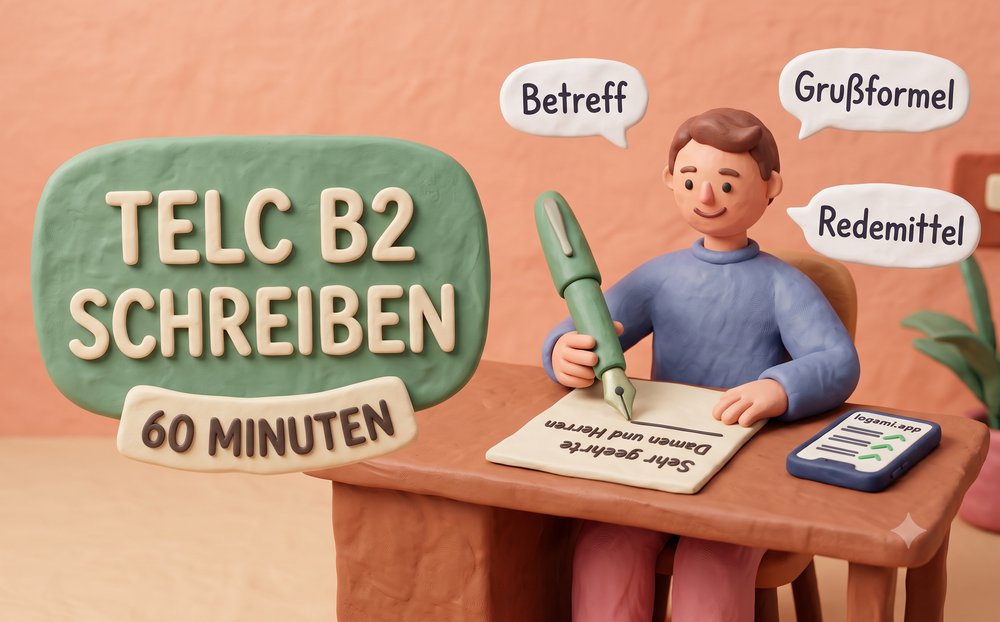
- Betreff: one factual line. Beschwerde über die Lieferung vom 12. Mai
- Anrede: Sehr geehrte Damen und Herren, or with a name if the task provides one
- Einleitung (1 to 2 sentences): why you are writing, with the key facts (what, when)
- Hauptteil (3 short paragraphs): one Leitpunkt per paragraph, each opened with a connector or Redemittel
- Schluss + Grußformel: a clear demand or request with a deadline, then Mit freundlichen Grüßen and your name
Model letter: Beschwerdebrief (task type seen in real exams)
Task: you ordered a laptop online, it arrived late and damaged, and customer service has not responded. Complain and demand a solution.
Betreff: Beschwerde über meine Bestellung Nr. 48213
Sehr geehrte Damen und Herren,
am 3. Juli habe ich in Ihrem Onlineshop einen Laptop bestellt, der laut Bestellbestätigung innerhalb von fünf Werktagen geliefert werden sollte. Leider muss ich mich nun aus mehreren Gründen bei Ihnen beschweren.
Zunächst einmal kam das Gerät erst nach drei Wochen bei mir an, obwohl ich es dringend für meine Arbeit benötigt hätte. Darüber hinaus musste ich beim Auspacken feststellen, dass das Display beschädigt ist, sodass sich der Laptop nicht verwenden lässt. Besonders ärgerlich finde ich jedoch, dass Ihr Kundenservice auf meine beiden E-Mails bis heute nicht reagiert hat.
Ich fordere Sie daher auf, mir bis zum 15. August ein einwandfreies Ersatzgerät zu liefern oder den vollen Kaufpreis zu erstatten. Andernfalls sehe ich mich gezwungen, rechtliche Schritte einzuleiten.
Mit freundlichen Grüßen
Anna Petrova
Notice what this letter does: three Leitpunkte in three paragraphs, each opened with a connector (zunächst einmal, darüber hinaus, besonders ärgerlich finde ich), B2 grammar where it counts (hätte benötigt, sodass, sehe ich mich gezwungen), and a concrete demand with a deadline. That is the full checklist an examiner needs to give high marks.
The mistakes that cost the most points
- Missing Betreff or Grußformel. Immediate deductions in communicative design.
- Wrong register. One du-form in a formal letter signals the wrong level.
- Writing 300 words. More text means more errors and no extra content points.
- Retelling the task. Develop your points instead of paraphrasing the prompt.
- No time for corrections. Plan 5 minutes at the end to check verb endings, cases, and commas.
How to train this in the next two weeks
Write one letter every second day under exam conditions: 30 minutes, no dictionary. Use the telc B2 Redemittel collection until the phrases come automatically, then get every practice letter scored. In the Logami telc B2 mock exam your letter is evaluated against the same three criteria described above, so you see your content, structure, and accuracy scores separately after every attempt.
Continue your TELC B2 preparation
Turn these phrases into a real score: practise on authentic TELC B2 exams, then explore the rest of the level.