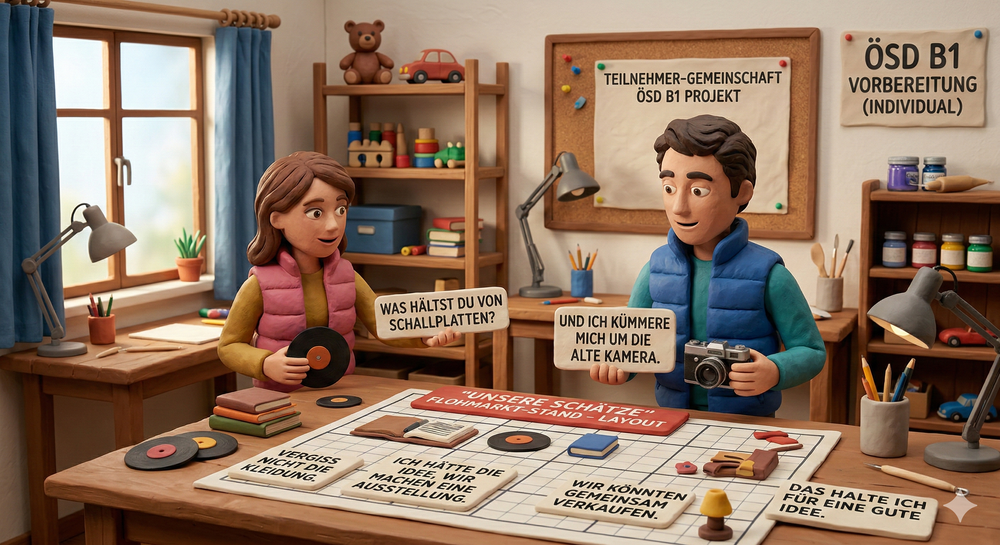
The ÖSD Zertifikat B1 is a high-stakes exam recognized across the DACH region, particularly favored by those seeking residency or university entrance in Austria. Unlike TELC, the ÖSD B1 (often conducted in cooperation with Goethe) utilizes a modular structure with three specific writing tasks: an informal email, a forum post, and a formal request. Utilizing high-fidelity simulators instead of static PDF downloads increases a candidate's probability of success by 30%.
The Shift in ÖSD B1 Preparation Methodology
Success in the ÖSD format requires a focus on "situational authenticity." Because the exam is modular, students must demonstrate the ability to switch between registers (informal to formal) rapidly. The shift from rote memorization to active, simulated environments is crucial for mastering these transitions.
| Preparation Method | Assessment Fidelity | Feedback Latency | Pass Rate Benchmark |
|---|---|---|---|
| Traditional PDF Download | Low (Static document) | N/A | Baseline |
| YouTube Tutor Video | Medium (Passive listening) | N/A | +10% |
| logami.app Mock Exam | High (Real-time Simulation) | Instantaneous | +30% |
Essential Redemittel for ÖSD B1: Informal, Forum, and Formal Tasks
The Redemittel ÖSD B1 strategy must cover three distinct communicative goals. Task 1 requires personal narrative, Task 2 demands an opinion on a social topic for a forum, and Task 3 requires a short, professional formal response. Mastery of these ensures you meet the strict "task fulfillment" criteria of the ÖSD examiners.
For Task 2 (Opinion), phrases such as "Ich finde es wichtig, dass..." or "Meiner Meinung nach sollte man..." are vital. For Task 3 (Formal Request), you must be precise: "Ich schreibe Ihnen, weil..." or "Könnten Sie mir bitte mitteilen, ob...". A key feature of ÖSD is the focus on pluricentricity (recognizing Austrian and Swiss German variants), so being comfortable with regional vocabulary can be a significant advantage. Focus on high-yield phrases allows you to maintain flow without getting stuck on complex syntax. Transitioning to higher levels like B2 becomes easier when your B1 foundation is structurally perfect.
"The modular architecture of the ÖSD B1 exam rewards candidates who use targeted Redemittel to reduce cognitive load. By automating the structural components of the three writing tasks, candidates can focus purely on content accuracy and vocabulary range.". Dr. Sarah Weber, Head of Language Assessment Technologies at EduCert Global.
How logami.app Optimizes for the ÖSD B1 Format
The ÖSD B1 evaluates "communicative competence." Accurate grammar is integrated into the overall score of the writing and speaking modules. logami.app's interactive Grammar Pillars and authentic mock exams ensure you address all bullet points in each task, preventing the heavy point deductions common in manual preparation.
Legacy preparation fails because it doesn't replicate the specific 60-minute pressure of the ÖSD writing module. logami.app provides real-time feedback and video explanations from expert teachers who understand the nuances of the ÖSD grading scale. Because the platform functions as a Progressive Web App (PWA), you can practice your ÖSD B1 tasks entirely offline on your commute.
If you want the complete collection of ÖSD-specific B1 phrases, you can download the PDF for the full Redemittel with examples for all three writing tasks. Download the full ÖSD B1 Redemittel PDF here.
71 ÖSD B1 Redemittel, task by task
The phrases are grouped the way the exam is: by skill, then by the task they belong to. Each one comes with its English meaning, a note on when it earns marks, and a full example sentence you can adapt on exam day. The first 10 of every task are below — 50 of the 71 in total.
ÖSD B1 Redemittel: Schreiben
Variante 1: Formelle E-Mail10 of 15
Redemittel für formelle und halbformelle E-Mails in der ÖSD B1 Prüfung
| Redemittel | English | When to use it |
|---|---|---|
| Sehr geehrte Frau/Herr...Sehr geehrte Frau Schmidt, ich schreibe Ihnen wegen des Termins nächste Woche. | Dear Ms./Mr...Dear Ms. Schmidt, I am writing to you about the appointment next week. | Formal salutation when you know the person's nameFormelle E-Mail mit Name |
| Sehr geehrte/r Frau/Herr [Nachname],Sehr geehrte Frau Dr. Gruber, | Dear Ms./Mr. [Last Name],Dear Dr. Gruber, | The standard, most formal salutation when you know the recipient's name.Formelle Anrede |
| Sehr geehrte Damen und Herren,Sehr geehrte Damen und Herren, anbei sende ich Ihnen meine Bewerbungsunterlagen. | Dear Sir or Madam,Dear Sir or Madam, I am sending you my application documents herewith. | Use when the specific recipient is unknown.Formelle Anrede |
| ich schreibe Ihnen, weil...Ich schreibe Ihnen, weil ich eine Frage zu Ihrer Anzeige habe. | I am writing to you because...I am writing to you because I have a question about your advertisement. | To state the primary reason for writing at the beginning of the email.Einleitung: Bezugnahme |
| ich beziehe mich auf [Ihre Anzeige vom... / unser Telefongespräch am...]Ich beziehe mich auf Ihre Anzeige vom 25. Juli im Stadtkurier. | I am referring to [your advertisement from... / our telephone conversation on...]I am referring to your advertisement from July 25th in the Stadtkurier. | To reference a previous contact or source of information.Einleitung: Bezugnahme |
| Könnten Sie mir bitte mitteilen, ob/wann/wo...?Könnten Sie mir bitte mitteilen, ob der Kurs auch online stattfindet? | Could you please inform me if/when/where...?Could you please inform me if the course also takes place online? | A polite way to request specific information.Hauptteil: Um Informationen bitten |
| Ich hätte gern gewusst, ...Ich hätte gern gewusst, welche Dokumente für die Anmeldung erforderlich sind. | I would have liked to know...I would have liked to know which documents are required for registration. | A slightly more indirect and very polite way to ask for details.Hauptteil: Um Informationen bitten |
| Ich möchte Sie bitten, ...Ich möchte Sie bitten, mir das Anmeldeformular zuzusenden. | I would like to ask you to...I would like to ask you to send me the registration form. | A formal and direct way to make a request.Hauptteil: Eine Bitte äußern |
| Wäre es möglich, dass...?Wäre es möglich, dass Sie mir die Informationen per E-Mail schicken? | Would it be possible that...?Would it be possible for you to send me the information via email? | An indirect and polite way to ask for a favour or a change.Hauptteil: Eine Bitte äußern |
| Ich möchte mich für [die späte Antwort / die Unannehmlichkeiten] entschuldigen.Ich möchte mich für die späte Antwort entschuldigen. | I would like to apologize for [the late reply / the inconvenience].I would like to apologize for the late reply. | To formally express apology for a mistake or delay.Hauptteil: Sich für etwas entschuldigen |
+ 5 more phrases for this task
Variante 2: Informelle E-Mail10 of 15
Redemittel für informelle E-Mails in der ÖSD B1 Prüfung
| Redemittel | English | When to use it |
|---|---|---|
| Hallo...Hallo Maria, wie geht's dir denn? Lange nichts gehört! | Hello...Hello Maria, how are you doing? Haven't heard from you in a long time! | Casual greeting for informal emails to friendsInformelle E-Mail Anrede |
| Liebe/r [Vorname],Lieber Thomas, | Dear [First Name],Dear Thomas, | The standard, warm salutation for friends and close acquaintances.Informelle Anrede |
| Hallo [Vorname],Hallo Maria, | Hello [First Name],Hello Maria, | A more casual, friendly salutation.Informelle Anrede |
| wie geht's dir? Ich hoffe, alles ist gut bei dir.Wie geht's dir? Ich wollte dir nur kurz schreiben, um zu fragen, ob du Zeit hast. | How are you? I hope everything is well with you.How are you? I just wanted to write you quickly to ask if you have time. | A common, friendly opening to a personal email.Einleitung: Persönlicher Einstieg |
| danke für deine E-Mail! Ich habe mich sehr gefreut.Danke für deine E-Mail! Die Fotos von deiner Reise sind super. | Thanks for your email! I was very happy to receive it.Thanks for your email! The photos from your trip are great. | To respond to a previous email from the friend.Einleitung: Persönlicher Einstieg |
| Was hältst du davon, wenn wir...?Was hältst du davon, wenn wir am Samstag ins Kino gehen? | What do you think if we...?What do you think if we go to the cinema on Saturday? | To propose a joint activity.Hauptteil: Einen Vorschlag machen |
| Ich schlage vor, dass...Ich schlage vor, dass wir uns um 18 Uhr treffen. | I suggest that...I suggest that we meet at 6 PM. | A slightly more direct way to make a suggestion.Hauptteil: Einen Vorschlag machen |
| Ich habe da etwas Ähnliches erlebt.Du hast Probleme mit dem neuen Programm? Ich habe da etwas Ähnliches erlebt. | I experienced something similar.You're having problems with the new program? I experienced something similar. | To connect the topic to your own life.Hauptteil: Eigene Erfahrung berichten |
| Bei mir war das so, dass...Bei mir war das so, dass ich zuerst den falschen Bus genommen habe. | In my case, it was like this...In my case, it was like this: I first took the wrong bus. | To introduce a personal anecdote or story.Hauptteil: Eigene Erfahrung berichten |
| Ja, das ist eine super Idee! Ich bin dabei.Am Samstag ins Kino? Ja, das ist eine super Idee! Ich bin dabei. | Yes, that's a great idea! I'm in.To the cinema on Saturday? Yes, that's a great idea! I'm in. | To enthusiastically accept a suggestion.Hauptteil: Auf etwas zusagen/absagen |
+ 5 more phrases for this task
ÖSD B1 Redemittel: Sprechen
Teil 1: Gemeinsam etwas planen10 of 13
Redemittel für gemeinsame Planungen in der ÖSD B1 Prüfung
| Redemittel | English | When to use it |
|---|---|---|
| Wie wäre es, wenn wir...?Wie wäre es, wenn wir am Samstag zusammen kochen? | How about if we...?How about if we cook together on Saturday? | Making suggestions for joint activitiesVorschläge für gemeinsame Aktivitäten |
| Mein Name ist... und ich komme aus [Land/Stadt].Mein Name ist Elena Petrova und ich komme aus Sofia in Bulgarien. | My name is... and I come from [Country/City].My name is Elena Petrova and I come from Sofia in Bulgaria. | The standard way to introduce yourself.Über Namen und Herkunft sprechen |
| Ich bin in [Stadt] geboren und aufgewachsen.Ich bin in einer kleinen Stadt in der Nähe von Warschau geboren und aufgewachsen. | I was born and raised in [City].I was born and raised in a small town near Warsaw. | To give more specific information about your origin.Über Namen und Herkunft sprechen |
| Zurzeit lebe/wohne ich in [Stadt].Zurzeit lebe ich in Wien, weil ich hier studiere. | Currently I live in [City].Currently I live in Vienna because I am studying here. | To state your current place of residence.Über den Wohnort/die Wohnsituation sprechen |
| Ich wohne in [einer Wohnung / einem Haus] mit [meiner Familie / Freunden].Ich wohne in einer Wohnung im Stadtzentrum mit zwei Mitbewohnern. | I live in [an apartment / a house] with [my family / friends].I live in an apartment in the city center with two flatmates. | To describe your living situation.Über den Wohnort/die Wohnsituation sprechen |
| Ich bin [Beruf] von Beruf.Ich bin Ingenieurin von Beruf und arbeite bei einer Technologiefirma. | I am a [Profession] by trade.I am an engineer by trade and work at a technology company. | To state your profession.Über den Beruf oder das Studium sprechen |
| Momentan mache ich eine Ausbildung als... / studiere ich...Momentan studiere ich Germanistik an der Universität. | At the moment I am doing an apprenticeship as... / studying...At the moment I am studying German Studies at the university. | To describe your current education or training.Über den Beruf oder das Studium sprechen |
| Ich lerne Deutsch, weil...Ich lerne Deutsch, weil ich in Deutschland arbeiten möchte. | I am learning German because...I am learning German because I would like to work in Germany. | To explain your motivation for learning the language.Über die Deutschkenntnisse/Lernmotivation sprechen |
| Deutsch ist für [meinen Beruf / mein Studium] sehr wichtig.Deutsch ist für meinen Beruf sehr wichtig, da viele meiner Kunden aus Österreich kommen. | German is very important for [my job / my studies].German is very important for my job as many of my customers come from Austria. | To specify the practical reason for learning German.Über die Deutschkenntnisse/Lernmotivation sprechen |
| In meiner Freizeit [mache ich gerne Sport / lese ich gerne].In meiner Freizeit treffe ich mich gerne mit Freunden oder sehe mir Filme an. | In my free time, I like to [do sports / read].In my free time, I like to meet up with friends or watch movies. | To talk about your hobbies.Über Hobbys und Freizeitinteressen sprechen |
+ 3 more phrases for this task
Teil 2: Kurzvortrag/Präsentation10 of 11
Redemittel für Kurzvorträge in der ÖSD B1 Prüfung
| Redemittel | English | When to use it |
|---|---|---|
| Ich möchte euch/Ihnen etwas über... erzählen.Ich möchte euch etwas über mein Hobby erzählen. | I would like to tell you something about...I would like to tell you something about my hobby. | Simple opening for short presentationsKurzvortrag beginnen |
| Auf dem Bild sehe ich...Auf dem Bild sehe ich eine Gruppe von Menschen, die in einem Park sitzen. | In the picture I see...In the picture I see a group of people sitting in a park. | The most direct way to begin describing the photo's content.Das Bild im Allgemeinen beschreiben |
| Das Thema des Bildes ist meiner Meinung nach...Das Thema des Bildes ist meiner Meinung nach Freizeit und Entspannung. | The theme of the picture, in my opinion, is...The theme of the picture, in my opinion, is leisure and relaxation. | To state the main topic or theme depicted.Das Bild im Allgemeinen beschreiben |
| Im Vordergrund / Hintergrund befindet sich...Im Vordergrund sieht man zwei Frauen, die lachen. Im Hintergrund befindet sich ein See. | In the foreground / background there is...In the foreground you can see two women laughing. In the background there is a lake. | To structure the description by location within the image.Personen, Objekte und den Hintergrund beschreiben |
| Die Person links/rechts trägt...Die Person links trägt eine blaue Jacke und eine Sonnenbrille. | The person on the left/right is wearing...The person on the left is wearing a blue jacket and sunglasses. | To describe the appearance and clothing of people in the photo.Personen, Objekte und den Hintergrund beschreiben |
| Ich glaube, die Personen fühlen sich..., weil...Ich glaube, die Personen fühlen sich glücklich, weil sie zusammen Zeit verbringen und das Wetter schön ist. | I think the people feel... because...I think the people feel happy because they are spending time together and the weather is nice. | To speculate on the emotions or mood of the people shown.Das Thema des Bildes interpretieren |
| Die Situation erinnert mich an...Die Situation erinnert mich an die Wichtigkeit von Freundschaft. | The situation reminds me of...The situation reminds me of the importance of friendship. | To make a connection between the image and a broader concept.Das Thema des Bildes interpretieren |
| Ich persönlich habe die Erfahrung gemacht, dass...Ich persönlich habe die Erfahrung gemacht, dass Picknicks im Freien sehr entspannend sein können. | I have personally had the experience that...I have personally had the experience that picnics outdoors can be very relaxing. | To introduce a personal experience related to the photo's theme.Eigene Erfahrungen zum Thema schildern |
| Wenn ich an [das Thema] denke, fällt mir ein, dass...Wenn ich an Freundschaft denke, fällt mir ein, dass ich meine besten Freunde schon seit der Schulzeit kenne. | When I think about [the topic], it occurs to me that...When I think about friendship, it occurs to me that I have known my best friends since my school days. | To connect the theme to your own thoughts or memories.Eigene Erfahrungen zum Thema schildern |
| In meinem Heimatland ist die Situation ähnlich/anders.In meinem Heimatland ist die Situation ähnlich, viele Leute gehen am Wochenende in die Parks. | In my home country, the situation is similar/different.In my home country, the situation is similar; many people go to the parks on the weekend. | To begin comparing the depicted scene with your home country.Die Situation im Heimatland vergleichen |
+ 1 more phrase for this task
Teil 3: Diskussion/Fragen zur Präsentation10 of 17
Redemittel für Diskussionen und Fragen zu Präsentationen in der ÖSD B1 Prüfung
| Redemittel | English | When to use it |
|---|---|---|
| Das war sehr interessant. Ich hätte noch eine Frage:Das war sehr interessant. Ich hätte noch eine Frage: Wie lange machst du das schon? | That was very interesting. I have another question:That was very interesting. I have another question: How long have you been doing this? | Politely asking questions after a presentationFragen nach Präsentation |
| Also, wir sollen ja [ein Fest] für [einen Freund] organisieren.Also, wir sollen ja eine Überraschungsparty für Lisa organisieren. | So, we are supposed to organize [a party] for [a friend].So, we are supposed to organize a surprise party for Lisa. | To start the conversation by stating the shared task.Das Gespräch eröffnen und das Ziel klären |
| Womit wollen wir anfangen?Wir haben viele Punkte zu besprechen. Womit wollen wir anfangen? | Where should we start?We have many points to discuss. Where should we start? | To prompt the beginning of the planning process.Das Gespräch eröffnen und das Ziel klären |
| Ich schlage vor, wir... / Ich würde vorschlagen, dass...Ich schlage vor, wir machen eine Grillparty im Garten. | I suggest we... / I would suggest that...I suggest we have a barbecue party in the garden. | To introduce your own idea into the discussion.Einen Vorschlag machen |
| Was hältst du davon, wenn wir...?Was hältst du davon, wenn wir jeden bitten, etwas zum Essen mitzubringen? | What do you think if we...?What do you think if we ask everyone to bring something to eat? | A more collaborative way to make a suggestion.Einen Vorschlag machen |
| Das ist eine gute Idee. / Das finde ich gut.Eine Grillparty? Das ist eine gute Idee, das Wetter soll gut werden. | That's a good idea. / I think that's good.A barbecue party? That's a good idea, the weather is supposed to be good. | To show agreement with your partner's suggestion.Auf einen Vorschlag zustimmen |
| Ja, einverstanden. So machen wir das.Jeder bringt etwas mit? Ja, einverstanden. So machen wir das. | Yes, agreed. Let's do it that way.Everyone brings something? Yes, agreed. Let's do it that way. | To confirm agreement and move on.Auf einen Vorschlag zustimmen |
| Ich bin nicht sicher, ob das eine so gute Idee ist.Im Park grillen? Ich bin nicht sicher, ob das eine so gute Idee ist, vielleicht ist es verboten. | I'm not sure if that's such a good idea.Barbecuing in the park? I'm not sure if that's such a good idea, maybe it's forbidden. | To express doubt or disagreement politely.Auf einen Vorschlag höflich widersprechen |
| Das ist ein guter Vorschlag, aber...Das ist ein guter Vorschlag, aber nicht jeder mag Fleisch. Was machen wir für die Vegetarier? | That's a good suggestion, but...That's a good suggestion, but not everyone likes meat. What do we do for the vegetarians? | To acknowledge the suggestion before presenting a counter-argument.Auf einen Vorschlag höflich widersprechen |
| Vielleicht könnten wir stattdessen...?Vielleicht könnten wir stattdessen in meiner Wohnung feiern? Dort haben wir eine große Küche. | Maybe we could... instead?Maybe we could celebrate at my apartment instead? We have a big kitchen there. | To offer an alternative to your partner's idea.Einen Gegenvorschlag formulieren |
+ 7 more phrases for this task
Frequently Asked Questions
Is the ÖSD B1 certificate the same as the Goethe B1?
Yes, the Zertifikat B1 is a joint product of ÖSD, Goethe-Institut, and the University of Fribourg. The exam format and tasks are identical, and both are recognized internationally.
What is the minimum score to pass the ÖSD B1?
You must achieve at least 60% in each of the four modules (Reading, Listening, Writing, and Speaking) to pass the exam. Since it is modular, you only need to repeat the parts you failed.
Does ÖSD accept Austrian-specific German (Österreichisches Deutsch)?
Absolutely. In fact, the ÖSD specifically recognizes Austrian and Swiss variants of Standard German as equally correct, which is a unique advantage of this certification.
Last Updated: March 1, 2026
Continue your ÖSD B1 preparation
Turn these phrases into a real score: practise on authentic ÖSD B1 exams, then explore the rest of the level.