How long you need for a German exam depends on two numbers: the distance between your current level and the target level, and the hours per week you can realistically study. This guide gives you honest benchmarks for both, plus the one phase almost everyone underestimates: exam-specific preparation after you have reached the level.
The hour benchmarks
Total guided learning time from zero, based on common CEFR estimates used by major providers:
350–650
hours to B1
Independent everyday communication
600–800
hours to B2
Work and study readiness
800–1,000
hours to C1
University and professional fluency
Step distances matter more if you already speak German: roughly 200 to 300 hours from B1 to B2, and another 200 to 300 hours from B2 to C1. At 10 focused hours a week, each step is five to seven months; at 20 hours a week, around three.
The phase people forget: exam preparation is not language learning
Reaching B2 and passing a B2 exam are two different projects. Once your German is at the level, plan 4 to 8 weeks of exam-specific training: learning the task formats, drilling the timing, and getting feedback on writing and speaking. Candidates regularly fail exams above their true level for format reasons, and pass exams at their level after two weeks of format drilling. The exam rewards people who know the exam.
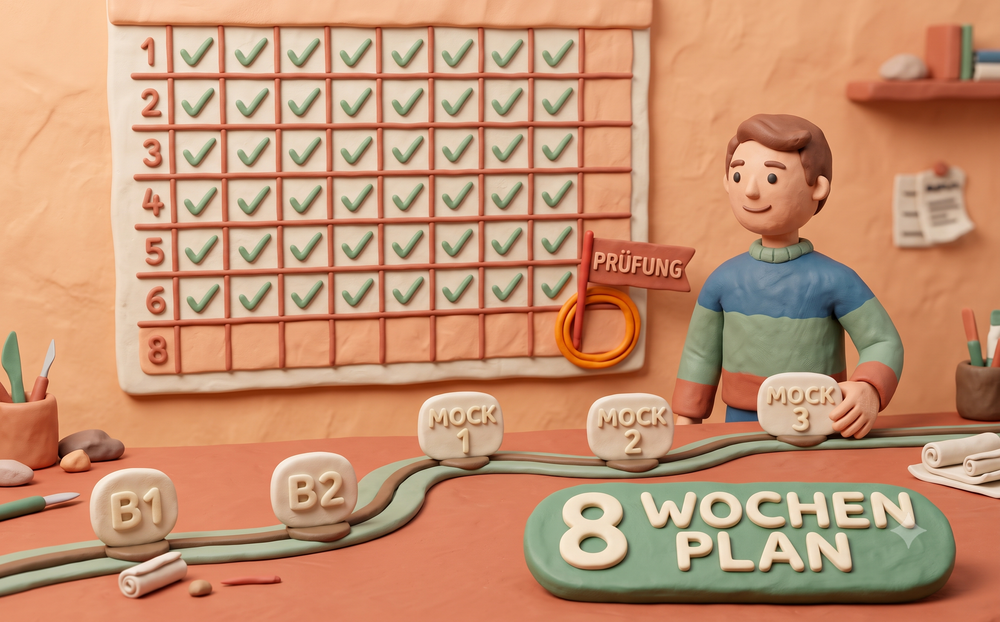
The 8-week exam plan in short
- Weeks 1 and 2: one full mock exam for a baseline, then study the task formats of every section
- Weeks 3 to 6: targeted training on your weakest sections, one timed mock per week, one scored writing task every second day
- Weeks 7 and 8: full simulations only, under strict exam conditions, until you hit the readiness margin (70 to 75 percent, three times in a row)
How to find out where you actually stand
Skip the guesswork: a full timed mock exam is the most accurate self-assessment there is, because it measures you against the real pass threshold of 60 percent per section. You can take a free mock exam without an account for telc, Goethe, or ÖSD at B1 to C1. Your section scores tell you immediately whether you are in the exam-preparation phase or still in the language-learning phase, and the per-exam overview pages show exactly what each exam demands.